Success! One post every day for an entire month! Let's see how long I can keep that up.
First of all, cheers to the new visitors; it's nice to see traffic coming through, especially if you're interested in reading my books. And some of you are; I had a couple of sales today, which is quite nice to see, especially in these quiet times of 'nobody's doing anything.'
So, now that I know people are watching, there's pressure to not disappoint. Which means, I have to have something to talk about! Politics and religion are out; there are plenty of blogs that discuss those topics, and I'm not really up for that here at this point. So, what else is there to talk about? My favorite topics, of course: Writing, history, education, music, gaming...it's all good stuff.
When it comes to history, I find that so much can be learned from reading primary sources. Instead of reading someone else's viewpoint on what happened during a particular historical event, in a textbook for example, I like to read things from the people who were actually there at the time. Here's an example of this:
When I mention the name 'Hernan Cortés,' most people will give me a blank look and ask if he's a Spanish soccer player. He wasn't; soccer didn't exist when he did his thing. When I mention 'Conquistador,' a few people will perk up, but the majority will still be clueless. But, if I say 'Cortés was the first European explorer in Mexico and conquered the Aztecs,' now I get the reaction! The spinal reflex today is to scream 'colonialism' and 'racism,' because we are a well-trained populace by now.
Here's the short version: Cortés and 500 of his men were planning a trip to explore west of Cuba when they were told not to by the governor of the island. Well, Cortés ignored him and left anyway, and landed at what we now know as Veracruz, Mexico. There, when his men grumbled about the risks in what they were doing, he ordered the ships burned, so the men had no choice but to see the job through. Despite their low numbers, the racist Spaniards defeated the Aztecs, who vastly outnumbered them, forced them all to convert by the sword, stole everything that wasn't nailed down, and destroyed a noble culture in the name of colonial imperialism.
That's the version you get in the history books, at least. The real story...doesn't quite fit that narrative.
See, Cortés certainly was planning conquest in the name of Spain, but he was also a devout Catholic who was appalled at the human sacrifices that were the primary aspect of the Aztec religion. I would hope that everyone reading this would have the same reaction.
So, as Cortés explained in a letter he wrote back to King Charles, he told Montezuma, the Aztec emperor, that the one true God found human sacrifice an abomination. In reply, Montzeuma told Cortés "That they had already informed me they were
not the aborigines of the country, but that their ancestors had emigrated to it many years ago ; and they fully believed that after so long
an absence from their native land, they might have fallen into some
errors; that I having more recently arrived must know better than
themselves what they ought to believe : and that if I would instruct
them in these matters, and make them understand the true faith, they
would follow my directions, as being for the best."
So much for converting by the sword. Now, to be sure, there was swordplay and bloodshed, and a lot of Aztecs were killed over the couple of years, but Cortés didn't start that. And the way Cortés described the city of Tenochtitlan, the capital of the Aztec Empire, doesn't suggest he thought them to be backward or primitive. On the contrary, he was fulsome in his compliments of how civilized they were, outside of the human sacrifice and worshiping of idols, of course. But in his own writings to the King, he compared the city favorably to cities such as Saville and Salamanca, important Spanish cities of the time.
Now, there's a lot more to the story, and I'm not going to pretend that the Conquistadors were living saints; they were certainly greedy and gold-hungry, and they were utterly certain of the righteousness of their mission, regardless of the human cost to the Aztecs themselves. But they put an end to the practice of human sacrifice, which gives them quite a few bonus points in my book.
Speaking of books...of course I am, because that's what I do. The one I haven't mentioned often lately is The Missing Magnate, the second Cameron Vail mystery. You'd be doing a great service to check it out and pick up your own e-book copy. And you might even enjoy it. There's no history in it, but there is mystery.
See what I did there? Rhyming. It's a catchy thing I learned about in marketing. I'll stop talking now.
Friday, May 15, 2020

Thursday, May 14, 2020
Amazing Stories #5, August 1926
Time to write another one of these, I suppose. I don't want to do them every day, of course, because there's no way I can actually read a whole pulp magazine in a single day, even during COVID-mania. Those things are packed with stories, about 90 pages of small type. But, the stories are fun to read, and really, that's what matters, isn't it?
So, let's see what the latest issue in my reading is all about.
COVER
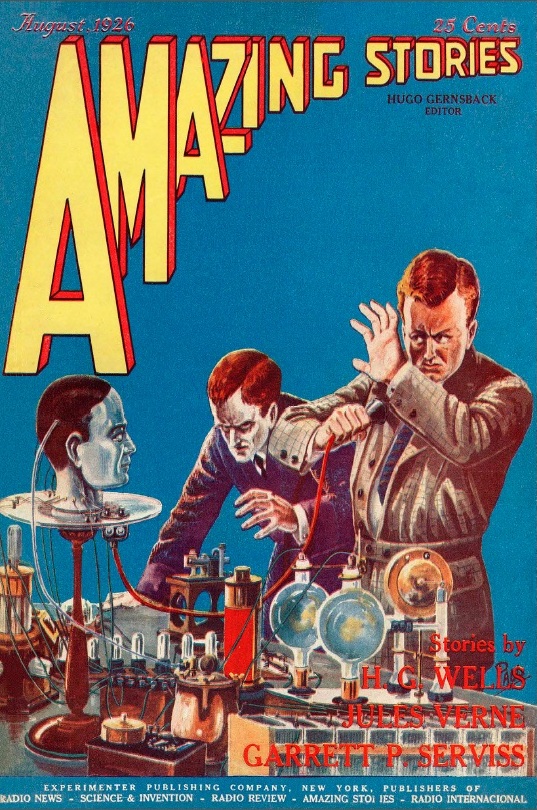
Okay...we've got a couple of sinister-looking men looking at what appears to be a metallic head on a small plate, with wires and electrodes linking it to a vacuum-tube machine. Well, that's different. So far, we've seen wider landscapes with the human characters being a minor part of the image, if they're even present. This time, it's a much more focused setting, as the scene is obviously getting away from exotic locations and sticking to a lab. The background is pure blue, so there's nothing but the men and their robot-head going on.
EDITORIAL
Gernsback gives us a run-down of how the stories being criticized as 'impossible' aren't necessarily so; technology is always changing, always improving, and who's to say what kind of life might exist outside of our atmosphere? There could very well be some sort of life form that can survive in a vacuum; just because we haven't encountered it doesn't mean it doesn't exist, right? Of course, he then points out that it's possible that there's life on the moon (which he believes to be true), which obviously turned out to be wrong. Still, it's a passionate defense of the 'maybe, we don't know' school of scientifiction thinking.
A COLUMBUS OF SPACE, Part I, Garrett P. Serviss
Ah, an excellent choice to lead off the issue. In the past I've talked about how a good story has to grab the attention, and realism isn't nearly as important as engaging the imagination with adventure and romance. Well, this story is a prime example of that. Sure, we can read it today and say, 'what an idiotic premise; everyone knows that Venus is uninhabitable and deadly, but when Serviss published this story in All-Story Magazine in 1909, nobody had a clue about what conditions on Venus were actually like. After all, it's engulfed in clouds.
So, this is a tale of a brilliant scientist and engineer who actually designs (again, 1909) a submarine-like device that can not only fly, but leave the atmosphere entirely and fly to other planets. Much faster than our current estimates, too; Edmund Stonewall (the titular Columbus of the story) figures out how to use atomic energy to power his masterpiece. He and three friends (including the narrator) embark on a journey that takes them to the wondrous planet Venus. There, they encounter strange alien beings on the 'dark side' of Venus, hairy ape-like men, one of whom ends up joining their expedition. They also encounter a race of beings that are much more human, and fly airships. Stonewall, of course, falls for the beautiful alien (but human) princess.
Does this sound at all familiar to anyone? It should, if you've ever read Edgar Rice Burroughs. It didn't strike me until right now, but Burroughs must have read this story, which predates his first novel, A Princess of Mars, by three years (in the same magazine that Burroughs sold his first stories to). Sure, John Carter gets to Mars by some unknown, astral means, while Serviss simply has his super-scientist build a working interplanetary spaceship, but there are plenty of parallels between the two stories. Burroughs is better known, since John Carter of Mars and Tarzan of the Apes are two of the most famous adventure characters of all time, and Serviss didn't write a recurring hero.
This serial covers 23 pages in total, almost all of them action-packed and fun to read. This went by quickly, and I highly recommend it to science fiction enthusiasts who want to be entertained, especially Burroughs fans.
THE EMPIRE OF THE ANTS, H.G. Wells
This short story first appeared in The Strand magazine, the same one that published all those Sherlock Holmes stories, back in 1905. It was reprinted in the American version of the same magazine the following year, then printed again this magazine twenty years later. It's six pages long, and basically recounts the attack of a colony of poisonous ants that turn on humanity.
It's not as apocalyptic as "The Star" was a couple of issues ago, but it certainly doesn't bode well for the future of the human race. Wells' anti-human ants are effective, efficient, and deadly in their coordinated attacks. The humans, by contrast, seem almost helpless in the face of the threat. The boat captain, in particular is portrayed as someone who should never have been given command of anything more complex than a rowboat. I don't know what Wells' overall view of humanity was, but he really sticks it to us in this one. I'm a bit tepid on this, as the most noble and heroic character, the stalwart Lieutenant, gets taken out by the ants. Sorry for the spoiler.
THE INTERNATIONAL ELECTRO-GALVANIC UNDERTAKING CORPORATION, Jacque Morgan
Yes, it's another Fosdick story, one that was first printed in Gernsback's Modern Electrics in December of 1912. I'll let Gernsback's own introduction speak for itself:
"Dr. Fosdick...takes a new departure and proposes to electroplate the dead in order to preserve them as beautiful statues for posterity."
Um, yeah. So, that's a thing that happened. And, as was the case in the first two stories we saw about Dr. Fosdick, it goes about as well as you would expect, i.e., not at all. He tests it out on someone who really should have known better, having been the victim of another one of Fosdick's experiments, and ends up trapped in a metal shell that he can't move in, and can't get out of. It's only four pages, and it's mildly amusing; perhaps the humor would have worked better back in the 1910s.
DR. OX'S EXPERIMENT, Jules Verne
Well, well...a short story by the master of scientific romance novels. How interesting. And this one is much less of an adventure and much more of a light-hearted romp than we're used to seeing from Verne. First published in 1874, this was its only appearance in the pulps.
So, what's going on here? Well, there's this little Flaemish town that doesn't appear on any maps. It's pretty much a complete dead-zone, in that nobody ever actually makes a decision to act. On anything. The town's leadership does meet regularly, but they are the ultimate bureaucrats: Doing absolutely nothing whatsoever. Three weeks into a fire in the leather-market, they still haven't bothered to do anything to put it out, except express regret that the accident that threatens to flood another part of the town didn't happen near the leather market to put out the fire and save them the trouble of having to continue talking about it. Yeah, it's like every city council meeting you ever heard of.
Anyway, Dr. Ox decides to liven things up by doing an experiment to change things in this sleepy town. How he does so, and what the effects of the experiment are, I will leave to the reader to discover. It's nineteen pages long, so it's not exactly a quick read, but it's not a serial, either.
THE TALKING BRAIN, M.H. Hasta
This is where the cover image came from, and allow me to make a correction: That wasn't a robotic head; it's was an actual human head, and the scientist in the story is communicating with the brain through his device. Yikes. This one is straddling the sci-fi and horror lines; it would not have been out of place in Weird Tales. However, this is an original story, and the author's only published pulp work. It was also never reprinted anywhere, so odds are pretty high you haven't read it before. It's only five pages long, so it won't take long to get to the climactic reveal at the end. Which I won't spoil.
HIGH TENSION, Albert B. Stuart, M.D.
And that makes two stories in a row that are a) original, b) never reprinted since, and c) the author's only published pulp work. It's a story about a doctor, written by a doctor. This doctor is a bit of an engineer, and gets to consult with the police on murders, including the one in this story. It's...not much of a mystery story, and more of a way to show off some new tech the doctor came up with. It's also only five pages long, and doesn't really have much to it. Frankly, I'm not surprised this writer never shows up again; it wasn't much of a story.
STATION X, Part 2, G. McLeod Winsor
The second part of this serial sees the actual hero of the story, Professor Rudge, take over the story. Macrae, the lead up until now, becomes a background character as he falls in behind Rudge. Rudge's primary goal here is to get himself to Station X with Macrae in tow, but Macrae is quite reluctant to do so...until one day, when he's fine with the idea.
There's a big chunk in the middle that's taken up with backstory on the various aliens involved in this story, as told by a 'Venerian,' which is really not the best name to use when you think about it. Call them 'Venusians' or something, man! 'Martian' worked fine for the bad guys, after all.
This installment takes up 21 pages, six of which are essentially backstory. So, it does drag in the middle. However, at the end things do pick up, as Rudge joins forces with the English Navy in an attempt to destroy the station before the Martians can use it as a staging base to psychically invade the whole planet. The third installment promises to be quite interesting.
CONCLUSION
And that wraps up another fine issue, with some great action (A Columbus of Space and Station X providing the majority of that), some comedy, and lots of 'someday this will be real' science. Seven stories in all, as three of them took up 20 pages each. All in all, a decent collection. Not necessarily the best, but it's nice to see some more original work come in, even though it's from authors who are never heard from again in pulp fiction.
So, let's see what the latest issue in my reading is all about.
COVER
Okay...we've got a couple of sinister-looking men looking at what appears to be a metallic head on a small plate, with wires and electrodes linking it to a vacuum-tube machine. Well, that's different. So far, we've seen wider landscapes with the human characters being a minor part of the image, if they're even present. This time, it's a much more focused setting, as the scene is obviously getting away from exotic locations and sticking to a lab. The background is pure blue, so there's nothing but the men and their robot-head going on.
EDITORIAL
Gernsback gives us a run-down of how the stories being criticized as 'impossible' aren't necessarily so; technology is always changing, always improving, and who's to say what kind of life might exist outside of our atmosphere? There could very well be some sort of life form that can survive in a vacuum; just because we haven't encountered it doesn't mean it doesn't exist, right? Of course, he then points out that it's possible that there's life on the moon (which he believes to be true), which obviously turned out to be wrong. Still, it's a passionate defense of the 'maybe, we don't know' school of scientifiction thinking.
A COLUMBUS OF SPACE, Part I, Garrett P. Serviss
Ah, an excellent choice to lead off the issue. In the past I've talked about how a good story has to grab the attention, and realism isn't nearly as important as engaging the imagination with adventure and romance. Well, this story is a prime example of that. Sure, we can read it today and say, 'what an idiotic premise; everyone knows that Venus is uninhabitable and deadly, but when Serviss published this story in All-Story Magazine in 1909, nobody had a clue about what conditions on Venus were actually like. After all, it's engulfed in clouds.
So, this is a tale of a brilliant scientist and engineer who actually designs (again, 1909) a submarine-like device that can not only fly, but leave the atmosphere entirely and fly to other planets. Much faster than our current estimates, too; Edmund Stonewall (the titular Columbus of the story) figures out how to use atomic energy to power his masterpiece. He and three friends (including the narrator) embark on a journey that takes them to the wondrous planet Venus. There, they encounter strange alien beings on the 'dark side' of Venus, hairy ape-like men, one of whom ends up joining their expedition. They also encounter a race of beings that are much more human, and fly airships. Stonewall, of course, falls for the beautiful alien (but human) princess.
Does this sound at all familiar to anyone? It should, if you've ever read Edgar Rice Burroughs. It didn't strike me until right now, but Burroughs must have read this story, which predates his first novel, A Princess of Mars, by three years (in the same magazine that Burroughs sold his first stories to). Sure, John Carter gets to Mars by some unknown, astral means, while Serviss simply has his super-scientist build a working interplanetary spaceship, but there are plenty of parallels between the two stories. Burroughs is better known, since John Carter of Mars and Tarzan of the Apes are two of the most famous adventure characters of all time, and Serviss didn't write a recurring hero.
This serial covers 23 pages in total, almost all of them action-packed and fun to read. This went by quickly, and I highly recommend it to science fiction enthusiasts who want to be entertained, especially Burroughs fans.
THE EMPIRE OF THE ANTS, H.G. Wells
This short story first appeared in The Strand magazine, the same one that published all those Sherlock Holmes stories, back in 1905. It was reprinted in the American version of the same magazine the following year, then printed again this magazine twenty years later. It's six pages long, and basically recounts the attack of a colony of poisonous ants that turn on humanity.
It's not as apocalyptic as "The Star" was a couple of issues ago, but it certainly doesn't bode well for the future of the human race. Wells' anti-human ants are effective, efficient, and deadly in their coordinated attacks. The humans, by contrast, seem almost helpless in the face of the threat. The boat captain, in particular is portrayed as someone who should never have been given command of anything more complex than a rowboat. I don't know what Wells' overall view of humanity was, but he really sticks it to us in this one. I'm a bit tepid on this, as the most noble and heroic character, the stalwart Lieutenant, gets taken out by the ants. Sorry for the spoiler.
THE INTERNATIONAL ELECTRO-GALVANIC UNDERTAKING CORPORATION, Jacque Morgan
Yes, it's another Fosdick story, one that was first printed in Gernsback's Modern Electrics in December of 1912. I'll let Gernsback's own introduction speak for itself:
"Dr. Fosdick...takes a new departure and proposes to electroplate the dead in order to preserve them as beautiful statues for posterity."
Um, yeah. So, that's a thing that happened. And, as was the case in the first two stories we saw about Dr. Fosdick, it goes about as well as you would expect, i.e., not at all. He tests it out on someone who really should have known better, having been the victim of another one of Fosdick's experiments, and ends up trapped in a metal shell that he can't move in, and can't get out of. It's only four pages, and it's mildly amusing; perhaps the humor would have worked better back in the 1910s.
DR. OX'S EXPERIMENT, Jules Verne
Well, well...a short story by the master of scientific romance novels. How interesting. And this one is much less of an adventure and much more of a light-hearted romp than we're used to seeing from Verne. First published in 1874, this was its only appearance in the pulps.
So, what's going on here? Well, there's this little Flaemish town that doesn't appear on any maps. It's pretty much a complete dead-zone, in that nobody ever actually makes a decision to act. On anything. The town's leadership does meet regularly, but they are the ultimate bureaucrats: Doing absolutely nothing whatsoever. Three weeks into a fire in the leather-market, they still haven't bothered to do anything to put it out, except express regret that the accident that threatens to flood another part of the town didn't happen near the leather market to put out the fire and save them the trouble of having to continue talking about it. Yeah, it's like every city council meeting you ever heard of.
Anyway, Dr. Ox decides to liven things up by doing an experiment to change things in this sleepy town. How he does so, and what the effects of the experiment are, I will leave to the reader to discover. It's nineteen pages long, so it's not exactly a quick read, but it's not a serial, either.
THE TALKING BRAIN, M.H. Hasta
This is where the cover image came from, and allow me to make a correction: That wasn't a robotic head; it's was an actual human head, and the scientist in the story is communicating with the brain through his device. Yikes. This one is straddling the sci-fi and horror lines; it would not have been out of place in Weird Tales. However, this is an original story, and the author's only published pulp work. It was also never reprinted anywhere, so odds are pretty high you haven't read it before. It's only five pages long, so it won't take long to get to the climactic reveal at the end. Which I won't spoil.
HIGH TENSION, Albert B. Stuart, M.D.
And that makes two stories in a row that are a) original, b) never reprinted since, and c) the author's only published pulp work. It's a story about a doctor, written by a doctor. This doctor is a bit of an engineer, and gets to consult with the police on murders, including the one in this story. It's...not much of a mystery story, and more of a way to show off some new tech the doctor came up with. It's also only five pages long, and doesn't really have much to it. Frankly, I'm not surprised this writer never shows up again; it wasn't much of a story.
STATION X, Part 2, G. McLeod Winsor
The second part of this serial sees the actual hero of the story, Professor Rudge, take over the story. Macrae, the lead up until now, becomes a background character as he falls in behind Rudge. Rudge's primary goal here is to get himself to Station X with Macrae in tow, but Macrae is quite reluctant to do so...until one day, when he's fine with the idea.
There's a big chunk in the middle that's taken up with backstory on the various aliens involved in this story, as told by a 'Venerian,' which is really not the best name to use when you think about it. Call them 'Venusians' or something, man! 'Martian' worked fine for the bad guys, after all.
This installment takes up 21 pages, six of which are essentially backstory. So, it does drag in the middle. However, at the end things do pick up, as Rudge joins forces with the English Navy in an attempt to destroy the station before the Martians can use it as a staging base to psychically invade the whole planet. The third installment promises to be quite interesting.
CONCLUSION
And that wraps up another fine issue, with some great action (A Columbus of Space and Station X providing the majority of that), some comedy, and lots of 'someday this will be real' science. Seven stories in all, as three of them took up 20 pages each. All in all, a decent collection. Not necessarily the best, but it's nice to see some more original work come in, even though it's from authors who are never heard from again in pulp fiction.
Wednesday, May 13, 2020
Debating Without Fighting
Those who are familiar with my Disqus posts across various blogs and news sites will know that I have rather strong opinions, and I can dish it out as well as take it when it comes to the occasional internet debate. I'm sure we have all seen at least one of these, where two opposing viewpoints cross, broadsides are launched willy-nilly, and the damage isn't even assessed until either one of them is sunk or, as is more often the case, when they drift away from each other long after anyone else has stopped paying attention.
Yeah, I've done that a few times. But it doesn't always have to be like that.
This morning, I called up a friend I've only seen a couple of times since Corona-mania swept the globe and we all crawled into our holes under government orders. It's frustrating, even for someone like me who doesn't have lots of friends, when you can't see the people you care about other than your immediate family. Not that I don't love my family; I wouldn't still be here if I didn't. But unless you're living out in the howling wilderness like Laura Ingalls family, interaction with other people is an important part of your daily life.
Anyway, I was just calling to catch up and see how his life was going; he's remodeling his house, because what else is he going to do now, right? So, we chatted for a while, and I'll be heading to his place tomorrow to help out. That's what friends do, social distancing or not.
A bit later in the conversation, he brought up a topic that I wasn't expecting: Evolution. See, my friend's a self-avowed atheist (he's more of an agnostic, not a hardcore 'flying spaghetti monster' atheist), and I'm a hardcore Roman Catholic of the old school, with all the traditionalist beliefs that entails.
I actually typed 'entrails' there at first. That's a whole different form of religion, one which my buddy and I are in full agreement on, that those people are wacko. Now, back to our regularly-scheduled blog post.
So, I wasn't planning to have this discussion, but I'm always game, and we have the advantage that we both know each other, and we don't fall into the 'you're an idiot' style of arguing that is all the rage today. And I use the word 'rage' deliberately; who hasn't had that kind of encounter online? If you haven't, you obviously haven't had internet access for the past decade, so how are you reading this post in the first place?
No, my friend and I debated the issue on the fly, without resorting to name-calling or personal attacks, because we value our friendship more than just being right about our beliefs. Which is good, because he's going to be heartbroken when he realizes he's totally wrong.
While I haven't had formal training in logic and fallacy, I know enough to avoid the obvious pitfalls, and he certainly has wide experience and training in both. So, we can sidestep the silliness and get to the point, which we did. Instead of screaming at each other at cross-purposes, we take good-natured pokes at each other, never in malice, and we present our points with what evidence we can scrape up on the spot. It was a lot of fun, actually, and I'm looking forward to continuing it in person.
My friend also has chef training, which segues into my third Cameron Vail murder mystery, Best Served Cold, now available on Amazon. my buddy was kind enough to read some of it and give me some tips and pointers on how the restaurant business works, so if it makes no sense, blame him.
Tuesday, May 12, 2020
Exploding Kittens and Other Silliness
So, my son's twelfth birthday happened on Sunday. I'm amazed he made it that far. There are days...
Anyway, he had a great day. It coincided with Mother's Day, so he made her breakfast. A bit later, we did the Happy Birthday thing for him. He had asked for something interesting for his birthday: He wanted mail. He wasn't asking for presents, he just wanted to get a couple of cards in the mail. Well, my wife is really good at this sort of thing. She put it out on Facebook that she was asking for people to send birthday cards to our son. The response was, in a word, awesome.
He got mail, alright; nearly forty cards from people, most of them total strangers. He got Scooby Doo, squirrels, Transformers, and all sorts of things that were really fun for him to read. I believe she posted the videos on Facebook; his reactions were amazing.
The best part was that he had seen four or five of the cards in the mail on Friday. I explained to him that he couldn't open them until his birthday, and that I was going to put them away so his younger brother wouldn't open them early. He didn't like it much, but I'm the Dad, so I win.
So, we handed him the five cards on their own, then let him open the presents from his family. He got a mini-Rubik's Cube, some glow-in-the-dark stars for his Harry-Potter-style book-cupboard under the stairs, and the titular Exploding Kittens game, which I had never heard of before. Thinking he was done, he was about to get up when I informed him that he had received the mail because of his mother's efforts to get it for him. After he thanked her, I then told him that there were a couple of others, and dumped the pile out of the bag. His eyes bugged out of his head, and his jaw dented the table when it dropped. It was a great time to be a parent.
He's writing thank-you notes to the people who gave return addresses, which is important. And he convinced his older brother (who will be 18 in November) to ask for mail, too. I don't think he's going to get the same thing, though. The twelve-year-old wasn't expecting what he got; the teenager does, which takes away from the experience.
Now, as for the Kittens...that is one weird game. It's funny, and it plays quickly. The object is to not draw an Exploding Kitten card, or rather to be the sole survivor when everyone else picks one first. The cards are hilarious (the Swarm of Bat Farts is particularly memorable, as is the 1,000-Year Back Hair Attack), the art is appropriately silly, and everyone had a good time. I suppose I can recommend it, since it's suitable for any age. Kids will love the silliness, and they'll pick up on the strategy easily enough. Adults will just shake their heads at the absurdity of it all, but they'll still play it, because what else are you going to do when you're still stuck at home by government fiat?
I mean, if you're not into playing games, you could always read a book. I would recommend Best Served Cold, the latest Cameron Vail mystery, available now on Amazon.
Monday, May 11, 2020
Back to School
What? It's mid-May. Back to school? Schools are closed! Haven't you heard? COVID is on the loose, and schools are a deathtrap! Why would you go back there now?!
It's online schooling, actually, and it's the Summer term, which is only going to July. That's pretty nice, since it will still count as a full set of credits. Anyway, the courses I'm taking are a course on European history (which is my major), and a course on ancient humor (which is going to be majorly fun). Two courses, nine credits, and that much closer to finally earning that degree I never knew I actually wanted or needed.
Having a degree these days is almost like having credit card debt; pretty much everyone has one, or is expected to have one. Actually, now that I think about it, it's exactly like having a lot of debt, because you can't get one anymore without going into debt. Here in Canada, it's not as expensive as in the States, but it's still not cheap. And it will be five years of college and university courses by the time I'm done next spring, which adds up a lot of debt. Even though I'm old, which means a good chunk of my student loan money is actually grants that I don't have to pay back, I'm still going to be on the hook for quite a substantial amount of money.
So, why am I getting the degree? Because it's difficult to get work without one, unless you're in the trades. And this body isn't built for the trades. It never was. Sure, I like to think I was athletic back in the day, but that day was way, way back. Now I'm arguing with my knees every time I crouch down with the catcher's mitt with my son pitching faster than I can. And he just turned twelve yesterday. I feel old. Who am I kidding; I am old. Age isn't just a number; it's a reminder that the good old days might not be as good as you remember, but enjoy them while you can, because eventually, you won't remember them.
Online education is great, really; you don't have to sit in a room with a bunch of indifferent, bored college-age kids. You don't have to do much group work (does anyone really like group work? If you do, you're not normal). You can take the time to think about the answer to a question without being on the spot. You can attend class pretty much whenever you want, wearing whatever you want. That's right; you can write your exams in your underwear, and who's going to know? So much for that nightmare.
It has its downsides, too, especially for younger people like not me. After all, college is where people go to do two things: party, and meet attractive people of the opposite sex.
What? It's not like they're getting an actual education, is it?
As I was saying...the social aspect of college goes right out the window when you go to online courses. So, the only people who are really going to thrive and get the most out of the online college experience are people who don't actually care about the social aspect. That's right, the nerds and geeks like me are in our glory. This is what we've been preparing our whole lives for! Limited social interaction, tons of computer and internet time, and no reason to go to bed on time instead of playing video games all night! We are living the dream, folks!
No, I'm not up all night playing video games; I have a family to deal with in the morning, remember? But if I could...I'm just saying.
So, it's back to heavy reading (like I hate that), pithy discussion board quotes, and the occasional online lecture. Piece of cake. One more year of this, and I can show off an embossed piece of paper! I can't wait!
Speaking of college life, my first published book is about that very subject. It's a murder mystery called Final Exam, and you can get it for the low price of $0.99 US on Amazon RIGHT NOW!!! Go ahead, I'm done now, anyway.
Sunday, May 10, 2020
With Extra Pulp
For a long time, the pulp magazines have had a bad rep. Trashy, cheap, inferior, mindless...all kinds of things have been said about them, when they are discussed at all. The oldest pulps, the ones prior to the time of Weird Tales and Amazing Stories especially, get the trifecta thrown at them: racist, sexist, and...well, not 'homophobic,' because the subject just didn't come up in the pulps. Society wasn't at the stage yet where that was a discussible topic. Discussable? I'm not sure on the spelling on that one; both get the red squiggly line.
Here's the thing, and I know this isn't a 'new' opinion, or even a 'retro' one; it's a thing that is growing in popularity. And that is, the pulps are superior to much of the 'literature' that is foisted on our kids today in schools and even in the bookstores and libraries. Controversial opinion? Sure it is; I've been reading a lot lately about how the pulps are from a backward time and everything since then is vastly superior. The only problem with that is, I don't see it. Sure, there are some modern authors I like (David Weber and Harry Turtledove being two prime examples), but the kind of stories I've been reading in the pulps just don't show up in modern writing very much. And that, my friends, is a tragedy.
I got interested in the pulps because I was reading some gaming blogs that were talking about the legendary 'Appendix N' in the back of the 1st edition DMG. From there, I also got interested in writing again, which is why I'm doing this blog. And that's when I started reading some of the old masters. Sure, I'd read Tolkien; who hasn't? And I had picked up some Burroughs for my son's homeschooling courses (any homeschooling program that has Edgar Rice Burroughs on its reading list is automatically superior to one that does not). But most of my reading in sci-fi and fantasy was modern, in the case of the fantasy, and post-Campbell for the sci-fi. I love David Eddings; he gets a bad rep today, but the Belgariad was the first epic fantasy I ever read, even before reading Tolkien. I received the first two books of the Belgariad and the first book of Isaac Asimov's Foundation series for my twelfth birthday from a friend. The Asimov...didn't do it for me. It didn't feel like what I expected science fiction to feel like. The Belgariad, on the other hand...I was hooked almost from the start, and I still read it regularly to this day.
But it wasn't until much, much later that I actually read fantasy that wasn't 'epic', derivative of Tolkien, or a D&D tie-in. I read Dragonlance and Forgotten Realms books because that's what I knew. I'd never even heard of Abraham Merritt or Lord Dunsany, let alone had any clue how foundational their writing was for modern fantasy, science fiction and horror. And I didn't even know that there was something out there I didn't know about, because I didn't hang out in used book stores, and I didn't know to look for them in the small-town library.
Now, though, I've been reading Burroughs, Merritt, Dunsany, some Clark Ashton Smith, and one Lovecraft story. I'm reading them in chronological order, because that's the sort of thing I do. So, I've read a ton of Burroughs; forty-two novels and short stories so far. I'm finally past World War I, so I'm looking forward to the Roaring '20s, which is still going to have plenty of Burroughs, more Lovecraft, more Dunsany, more Merritt...and more new guys I don't even know yet. And, since I'm also reading Amazing Stories, there will be plenty more, as well. I was considering doing Weird Tales readings as well, but there's only so much time available. Dammit.
There's something about the pulps that we've lost today. That sense of real heroism, people making a difference, and the values they held. We just don't see that these days, not in the majority of genre fiction, at least. And that's a shame.
Ironically, it wasn't the pulps themselves that made me realize this; it's that Laura Ingalls Wilder book my son and I are reading together. We're four chapters in, and so far, 'Pa' has demonstrated a yeoman's skill at hunting, animal husbandry, trapping, carving, whittling, bullet-making, fiddle-playing, literacy...oh, let's not forget architecture and excavation, since he built this house in the backwoods of Wisconsin and dug a cellar underneath it, too. And there's nothing special about Pa; he's just a typical pioneer, making his way in the world with his wife and three daughters. That was normal for that time period, and even by the time of the First World War, it still wouldn't be considered unusual. But today? The number of men who would be able to competently perform half of those things is vanishingly small. We don't need to, after all; pretty much everything we need is available at a big box store. Nobody needs to butcher their own pig, after all.
Still, it speaks of a time when we were truly different, and that time is lost to us for the most part. There are no home movies, no audio recordings. But we do have the writings, and there's a lot they can teach us. Yes, they had different social attitudes toward minorities and women. That doesn't negate the good things they did have. If any negative characteristic disqualified people from having anything to teach and pass on, then we're finished as of right now, because there ain't nobody who doesn't have some negative characteristic. Except my wife, of course.
There are people who are trying to bring back that ethos, that sense of a nobler purpose for mankind, and that sense of fantastic wonder that we are missing today. Men like Brian Niemeier, Jeffro Johnson, and Larry Correia, men who are determined to break the straitjacketed rules of fantasy and science fiction and bring back that joy once again. So, if you're searching for something different, something exciting and new, look to authors like these, who are opening up whole new worlds of wonder to explore.
And, when you're done with them, check out my own anthology of science fiction, fantasy, and other stories, A Universe of Possibilities. Hopefully, you'll find something you like there.
Saturday, May 9, 2020
Then and Now
I was walking the dogs with my middle son tonight, and we had a good talk. We recently decided on a special weekly reading assignment for him: In addition to his regular homeschooling work, he is going to be reading one book a week and reporting on it the following weekend. The book we assigned to him today was Little House in the Big Woods by Laura Ingalls Wilder. That's 'Little House on the Prairie', for you older folks. We picked it because it's not really a challenging book; it's written for younger people, after all, so it's not like I handed him Moby Dick.
Anyway, we read the first two chapters together today. At first, he wasn't that much into it; after all, it's the story of a little girl growing up in backwoods Wisconsin 150 years ago. How exciting can that be, right?
Turns out, it's quite interesting, even for a boy about to turn twelve. The descriptions of the smokehouse and butchering the hog got his attention, and the story of how Grandpa got away from a panther was riveting.
On the walk, we talked about what life was like back then compared to now. I pointed out that Wilder, born in 1867, was 36 when the Wright Brothers took off for the first time, and died shortly before the launch of Sputnik in 1957.
Can you imagine the changes that generation experienced? They didn't even have light bulbs when they were kids; the Civil War was still fresh and raw; Canada was a brand-new country. By the time they were gone, the world had fought two horrifying industrial wars, and the final frontier had been breached.
There's never been a societal shift of that magnitude before, and I doubt there ever will be again. Jules Verne was writing fantastical stories about submarines and moon shots, and by the time Wilder was gone, those things were a reality. How did they process that shift? There's no one alive today, obviously, who can remember those things; the Wright Brothers first flight was in 1903, 117 years ago. Of all seven billion people alive right now, there is a grand total of ONE person who was alive in 1903, a Japanese woman who was less than a year old then. So, there's no one left who remembers a time when men couldn't fly. When compared to recorded human history, it's the blink of an eye. But it's now four full generations since that happened.
And people wonder why I'm studying history in school. There is no more fascinating subject than history; it's also the most important one. That's why books like Laura Ingalls Wilder's tales are valuable to us, because they give us a window into a different time. A simpler time, yes, in many ways, but that doesn't mean inferior. The past has so much to teach us, which makes me wonder why so many people are so determined to erase it. Schools don't teach history, or if they do, it's a dull, watered-down version with so much revisionism and outright invention that it's no wonder kids don't pay attention to it and think it's boring.
Those who fail to learn from history are doomed to repeat it. We've seen that time and time again, and those of us who have learned from history are watching it all happen again. And for all those people that say, 'it can't happen here', well...it's not the first time that's been said, either.
If you're interested in history, check out my first fantasy novel,which has historical tie-ins: The Chronicles of Meterra: Arrival, available in e-book and in paperback. And leave a comment; it's nice to know what other people think.
Friday, May 8, 2020
Weird Fantasy and Gaming Heaven
Okay, four straight days of Amazing Stories reviews...time for a break. I'm going to continue doing those reviews, because it's a great magazine, and there's some serious awesome coming up in those early issues. But there are other things going on in the world besides that.
I'm tempted to go on a COVID-rant, but I'd rather keep things more upbeat and positive. So, I'll talk about something more interesting and less ubiquitous in the news. So, I'll talk about one of my favorite subjects instead: Gaming.
I'm still looking for another opportunity to teach my son more of the finer points of skewering goblins and skeletons; it will happen eventually. But I'm looking back on when I first learned about RPGs, and D&D in particular.
I was twelve, and I was the stereotypical loner kid, comfortable with sitting in my room and doing my own thing, which usually involved reading. I had taken to reading some old kid's fantasy books at the local library, including the Oz series by L. Frank Baum. One week, as my dad was bringing me in to the library to get my week's supply of books (I'd usually take out six or seven), we saw an ad for the weekend D&D game that the library had started hosting. Yes, this was before the Satanic Panic, when gamers went underground until the dark times had passed. I wasn't all that interested, but my father decided that I needed to do some socializing, and since I had shown an interest in fantasy fiction, he took it upon himself to bring me back on the weekend to meet the local D&D group.
I had no rulebooks, I had no dice, and I had no clue what was going on. But the group graciously let me join in; they had an extra character 'sheet.' By 'sheet,' I mean they had a thin strip that they had cut out of a photocopy of the list of pregen characters in the back of the Giants series of modules. That's right, my first-ever experience with D&D was as Beek Gwenders, high-level half-elf ranger.
You know that passage in the 1st edition Dungeon Masters Guide where Gary Gygax recommends that new players be started off in a separate game, to give them the opportunity to experience first-level play? Yeah, these guys weren't having any of that. And they weren't going to cut away from the adventure they were currently playing in, either. It wasn't the Giants modules; that was just where they'd gotten the characters from, and they'd already finished those modules. No, they were exploring a strange 'cave' in the side of a mountain, a cave made of smooth metal with tons of crazy critters in there like vegepygmies and security robots.
That's right, old-timers; you know what I'm talking about. We were going through the Expedition to the Barrier Peaks. And I'd never even held a twenty-sider before. I didn't know what anything on that little strip of paper meant. But something inside me loved every second of it. I had no idea that this wasn't 'real' fantasy, with robots and spaceships and alien gardens. It was weird, it was fun, and I was hooked.
I still didn't have any rulebooks, but within a few weeks I was making up my own version of the game. I had tables of magic items for sale, a rudimentary list of spells for the wizards (I didn't even know there were other spellcasters, and I was playing a ranger), and vegepygmies were the main monster on my encounter tables. It was crazy, but I loved it.
A few weeks after that, I found out that the library actually had a copy of the Moldvay Basic rulebook. The guys I was playing with said that wasn't the real game, but I didn't care. I borrowed the book and read it cover-to-cover three times in a week. Now, I knew what I was doing. I bought a few dice (no twelve-sider yet, and we had lots of board games, so I didn't need another six-sider), rolled up a bunch of characters, and began a life-long obsession and love.
Now, I'm hoping to pass that on to my son. It's going to be a slow process as long as my wife continues to resist, but I'm confident that will change. But until it does, I'll just make sure he keeps reading the books that inspired the game, including the Barrier Peaks. Because if it's that weird, it's definitely fantasy.
Speaking of fantasy, allow me to point you to my first fantasy novel, The Chronicles of Meterra: Arrival, available in e-book or in paperback.
Thursday, May 7, 2020
Amazing Stories #4, July 1926

Another issue of Amazing ready to go. This one has nine
stories within its cover, and there are some entertaining ones here. Even at
this early stage, there is a definite sense that even though Gernsback wanted ‘realistic’
science in his stories, it’s clear that the story is more important than the
science. Well, except for that last story in issue #3; that was the exception
to the rule.
COVER
The cover introduces us to a huge fly that is menacing a
naval warship, with sailors manning a deck gun and shooting at it with rifles.
That is one ugly fly, with huge pincers to take a man’s head off. The bullets
don’t seem to bother it, either. That’s going to be a fun story. Oh, and there’s
a new name on the cover: Garrett P. Serviss, who I’ll talk more about later. He’s
a good one.
EDITORIAL
Gernsback wishes to discuss ‘fiction versus facts,’ and how
there is an introductory blurb before every story explaining how the science
within is in fact probable for some future date. And I just noticed the
masthead: “Extravagant Fiction Today…Cold Fact Tomorrow”. So, he’s certainly
got some optimistic views on the stuff he’s printing. Either that, or it’s just
good marketing. But considering the sorts of magazines Gernsback used to run, I’ll
bet on the former.
Anyway, Gernsback spends most of a page explaining how the
science in these stories is quite plausible, and how he expects that within a
generation or so, the fiction will be fact. I hope he’s not including stories
like “The Star”, because that would have sucked if it became fact. I find this
assertion of his amusing, since he’s reprinting stories from a previous
generation; Wells, Verne and others are not modern writers, after all, even in
1926. There’s also a corroborating view from G. Peyton Wertenbaker, the 19-year-old
who wrote “The Coming of the Ice” for last issue. Well, that’s settled, then.
Where’s my flying car?
Actually, it’s not like that. Wertenbaker simply points out
that the magazine’s focus is on getting the right balance of science and
fiction, something which Gernsback agrees with; he even includes a ratio of 3:1
for story over science. I approve of this; the story must come first, or the
science is irrelevant (as the Dr. Hackensaw ‘story’ last issue proved).
STATION X, Part 1, G. McLeod Winsor
This is our new serial story, part one of three. It was
originally published in 1919, and is Winsor’s only pulp-published work. He did write
a couple of other novels, but they never made it to the pulps. The story is nineteen
pages long, with six chapters in this issue. It’s a story about aliens
psychically invading Earth, and Gernsback hails it in the intro as ‘the greatest
radio story that was ever written.’ Well, that’s pretty high praise.
Our hero is Alan Macrae, who is not military, but gets
assigned to the titular Station X for some unknown reason. While he is there,
he is overcome by the strange voices he is hearing over the wireless system. When
the ship that brought him there returns, they find him comatose, believing him
to be dead. Although Macrae wasn’t alone, there is no sign of the other men on
the island. It turns out Macrae isn’t actually dead, and they bring him back
home.
In the diary he had been keeping, the ship’s officer’s learn
that he was actually in contact with an alien psyche on Venus, who was warning
him about a similar alien presence from Mars which is planning to psychically invade
Earth. The last chapter in this installment installs Professor Rudge, the
ultra-genius scientist who, as is the case in many of these stories, is Earth’s
only hope to learn the truth and save the world. We end with Professor Rudge
planning to visit Station X himself to find out what’s going on.
It’s an interesting story, but it involves psychic aliens on
not one, not two, but three extra-terrestrial bodies: the Moon, Mars, and
Venus. It also drags on a bit as much of the exposition comes in the form of
Macrae’s diary, which gets extensively quoted and bogs down the action of the
story. Hopefully, things pick up in the next installment.
THE MAN WHO COULD WORK MIRACLES, H.G. Wells
First published in the Illustrated London News in July of
1898, this story is a great example of how science fiction and fantasy weren’t
considered separate genres at this time. There’s no real science in this story;
Mr. Fotheringay simply gets the power to perform miracles, like instantly
completing his office work. He then goes to church on Sunday and discusses it
with the pastor, who enthusiastically suggests he start helping people.
Unfortunately, things go somewhat awry, and everyone dies.
Oops…should have put a spoiler alert on that one. Seriously,
everyone dies. EVERYONE. Wells didn’t kill this many people in “The Star.” But
unlike that story, things do get fixed at the end. It’s as much a morality tale
as it is a fantasy, and it’s got some sharp humor as well. It’s seven pages
long, and reads quickly. Gernsback recommends reading it twice to get the full
effect; I read it once and got the point easily enough.
THE FELINE LIGHT AND POWER COMPANY IS ORGANIZED, Jacque
Morgan
Another Mr. Fosdick tale, this one was actually the first
one he published for Gernsback in Modern
Electrics back in 1912. It’s even more absurd than last issue’s story,
believe it or not. Essentially, the redoubtable Mr. Fosdick comes up with the ‘ingenious’
idea of rubbing a cat’s back with resin to generate and store static electricity.
Yes, it’s as silly as it sounds, and has a resolution worthy of such a concept.
Suffice to say that Mr. Fosdick will get back to the drawing board once the static
charge in his own body dies down…in nearly a thousand years.
At less than four pages, this one packs a lot of humor in
with its absurd scientific premise. Even Gernsback can’t have thought this
would become an actual thing in a generation or so. It’s worth a quick read,
but that’s about it.
THE MOON METAL, Garrett P. Serviss
Alright, now we’ve got something. Mr. Serviss was well-known
as a sci-fi writer back in the time of Burroughs and Kipling, but he was better
known as an actual astronomer. Serviss was on the leading edge of astronomy in
his time, and wrote a lot of non-fiction books on the subject with the intent
of educating laymen. He only wrote a few science fiction stories, including
this one, which was his only short story that survives. He also wrote one
called ‘An Event in Boundless Space’, which appeared in Short Stories magazine in September of 1890, but I can’t find a
trace of it on the internet. I’d love to read it someday, though.
As for “The Moon Metal,” this one first appeared in 1900,
and was reprinted in All-Story in May
of 1905. It’s 23 pages long in this magazine, which makes it a novella, rather
than a short story. It tells the tale of a pair of scientific investigators who
are attempting to discover why someone is mining a new metal that has suddenly
become the world’s base currency. Obviously, it’s alien in nature, and aliens
are behind it, because aliens are behind everything. In the end, the super-scientist
finds a way to duplicate the metal, and uses it to…no, read it yourself.
I’m doing the story an injustice; it’s well-written, and
Gernsback gushes about it in the introduction. He obviously thought highly of
Serviss, for good reason; the man knew how to write a ripping good yarn, and he
didn’t talk down to his audience. We’ll see him again in these pages.
THE EGGS FROM LAKE TANGANYIKA, Curt Siodmak
Curt Siodmak presents our first brand-new story for this
issue, and it’s his first published pulp work. He was 24 when this story was
printed, and lived to be 98 and see the new millennium. He obviously wrote a
good story; this is the one that the cover picture comes from. That’s right;
Wells, Verne and Serviss are in this issue, but the newcomer gets the cover.
Sweet work.
So, the cover spoils what this one’s about: giant insects.
That fly on the cover? It’s a tse-tse fly, one of the nastier types of flies.
And that fly on the cover isn’t the only one; there are four of them, each one
big enough and hungry enough to drain a horse dry of blood. The story, which
covers only four pages, is a race to catch them all before they can lay any
eggs. There’s suspense, creepy horror, and scientific stuff all gathered
together, and it ‘s a good story.
THE MAGNETIC STORM, Hugo Gernsback
Well, well…Mr. Gernsback is throwing his own name into the
pot, and has one of his own stories in this issue. It’s the first of his many
short stories to get reprinted here, and it won’t be the last. This one first
appeared in August 1918 in the Electrical
Experimenter magazine, an earlier project of Gernsback’s. According to
Gernsback’s introduction, the science was personally approved by Nikolai Tesla
himself.
Basically, the story is Gernsback’s attempt to create a ‘death
ray,’ a ray that can be used in the Great War to defeat the Germans. Of course,
it’s not actually a ‘death ray,’ it’s simply a novel way to turn telegraph
poles into an oscillator coil that will burn out equipment across Germany and
Austria, ending the war on the spot.
Being a history major, I’m pretty certain that didn’t
actually happen. Gernsback isn’t the most talented writer, but he is certainly
imaginative, and he did predict a bunch of future inventions in some of his
stories. This, however, was not one of them. Just over six pages long, it’s a
quick read, but it’s not so interesting that I’ll go back to it again.
THE SPHINX, Edgar Allan Poe
The Great One returns after skipping the last issue. Poe,
known for his short works, sets the new record, with a story that clocks in at
a mere two pages in length. First published in Jan 1846 in Arthur’s Ladies Magazine, it is set in New York during the cholera
outbreak of 1832. The narrator, who is into omens and such, sees what he thinks
is a ginormous winged creature with a death’s head on its back. Turns out it’s
not quite what he thinks, and he’s not actually going to die. Of course, Poe
did die only three years later, so maybe he had an omen of his own.
It’s Poe, so it’s a good-quality story. Of the three we’ve
seen so far, I’d say it’s the second-best after the M. Valdemar story in the
first issue. I always recommend Poe.
A TRIP TO THE CENTER OF THE EARTH, Part 3, Jules Verne
At last, the thrilling conclusion! Serials were the pulps’ best
weapon to ensure continued readership; even if some of the stories weren’t very
good, you had to keep coming back just to see what happened next. Of course,
this wasn’t exactly an obscure story; Jules Verne was even more of a titan then
than he is now, and this was one of his most famous tales. Unlike the first
installment, this one doesn’t seem to have cut much out, as there’s plenty of
action and adventure to be found. They don’t actually encounter any prehistoric
people, but this installment becomes a race against time as they have to find a
way to escape before they get eaten by the various prehistoric creatures that
aren’t actually extinct down here. The escape is well-known from dozens of
adaptations and pastiches; they basically use their raft to ride up a volcanic
eruption, and instead of being in Iceland they’re in Italy. But they get home,
safe and sound, and they all live happily ever after.
This installment covers fifteen pages, and is quite the
thrill-ride. Even for people who were familiar with the story, this was reason
enough to buy the magazine back in 1926. We need more stories like this today.
THE SECRET OF THE INVISIBLE GIRL, Clement Fezandié
On the other hand, there’s this story…another Dr. Hackensaw tale.
At only three pages, it’s sufficiently short to not be a total drag. Again,
there’s no real action, just a framework to demonstrate a new device. It doesn’t
even have a happy ending; it’s actually a bit depressing. And I don’t like
depressing. There’s no explanation for the invisibility, or any real character;
there’s just nothing to it. Fezandié may have had some imaginative ideas for
invention, but his storytelling just plain sucks. This is an original, and it’s
the last thing Fezandié ever published in the pulps. I can’t he’ll be missed.
BONUS
To my surprise, I found a letter at the back of the magazine,
written by George Allan England, who wrote the creepy story “The Thing from
Outside” from the first issue. He’s an enthusiastic science disciple, scorning ‘worn-out
old religious dogmas’ and ‘hoary old superstitions’ in his eagerness to see
more scientifiction printed so as to educate the masses as to the reality of
science vs. the superstition of religion. Well, he’s a true believer, at least.
CONCLUSION
This was a good issue, with some thrilling stories and a couple
of clunkers, much the same as the last issue. I think the magazine is starting
to hit a stride, and while the majority of the stories are reprints, the new
writers are going to make a splash in time. Gernsback was definitely onto
something with this magazine, and the imagination is just beginning.
Wednesday, May 6, 2020
Amazing Stories #3, June 1926

Well, I’m going to continue with the Amazing Stories
magazine reviews, just ‘cause. They’re fun to read, and even though the
contents are all reprints so far, I know I have some great stuff to look forward
to eventually. Mind you, I haven't read that far into the magazine's run thus far, so don't expect this daily thing to continue for long. With that in mind, issue number three:
COVER
We see three men on a raft in the middle of the sea, lake or
ocean, facing off against a sea serpent underneath a red sky. There’s also a
giant turtle head looking on in the bottom corner. This, if I’m not mistaken,
is taken from the Trip to the Center of the Earth story. It’s definitely
evocative, and you just know that someone on that raft is about to be eaten. It’s
a pretty flimsy raft, too; waves like that should tear it apart.
EDITORIAL
“The Lure of Scientifiction” is the title, and Gernsback namedrops
Poe as one of the founders of sci-fi (in America, certainly, but there were
some in Europe, even before Mary Shelley). He also throws in a mention of
Leonardo da Vinci as someone with the imagination to write science fiction. He
then brings up Roger Bacon, a medieval scientist who had to be careful not to
run afoul of the religious authorities. This is, of course, a myth; there were
plenty of Catholic clergy involved in scientific research at that time,
including Bacon himself, who was a Franciscan friar. Unfortunately, the myth of
‘Catholic Church is anti-science’ has deep roots.
A TRIP TO THE CENTER OF THE EARTH, Part 2, Jules Verne
In this second part, the intrepid heroes continue their explorations
of the deep underground caverns. They do not, of course, actually reach the
center of the Earth; that would happen much later, when Edgar Rice Burroughs
wrote the Pellucidar books. But they do get significantly deep, and run across
some fantastic terrain, including the underground sea shown on the cover, and a
mushroom forest that includes the bodies of what can only be prehistoric
cavemen of large size. They do get separated, and there’s a terrifying scene
where the narrator is lost, with no way to find his way back to the others,
miles underground. The terror he feels when he realizes that no one will ever
even find his body is palpable. Twenty chapters of underground exploration
cover thirty-five pages, the longest story in this issue. A good start to the
magazine, and the conclusion of the story will be in the next issue.
THE COMING OF THE ICE, G. Peyton Wertenbaker
Well, I missed something in the previous review. It turns
out that the second Man from the Atom story, by this same author, actually was
an original story, not a reprint. And so is this one; Wertenbaker has the
distinction of being the first author to have a story first printed in this
magazine, and he’s done it twice in two issues. And today, he’s such an obscure
figure in science fiction that he doesn’t even get his own Wikipedia page.
This one is a sort-of post-apocalyptic story, taking place
in an indeterminate future year. All the narrator knows is that he’s immortal
through some voluntary experiments, and there aren’t any more people like him;
they’ve evolved (or devolved) into something else entirely, while he’s the same
as he was back in 1930. Well, that’s a downer. He can’t even see the sky
anymore to look at the stars and wonder if there’s anything else out in the
cosmos, because it’s constantly snowing. It’s an environmentalist’s direst
nightmare: the world devolved into global cooling, the return of the ice age.
But before that dreary, depressing ending, the story shows
that humanity does indeed let science reign supreme, and achieves mechanical
perfection…until there’s nothing left to discover, nothing left to invent, and
society stagnates and falls apart because there’s no reason to go on. But
unlike everyone around him, our narrator will go on, even after everything else
is gone. It’s an interesting story, warning that science can only go so far to
improve human existence. And Wertenbaker was only nineteen when he wrote it.
The story is only five-and-a-bit pages long, but packs some solid food for
thought in there.
MR. FOSDICK INVENTS THE “SEIDLITZMOBILE”, Jacque Morgan
We move on from the dreary and depressing to the absurd and
humorous. This is actually one of five Mr. Fosdick stories that Jacque Morgan
wrote, and he was actually dead when this one was published in Amazing Stories,
having died the previous year. It’s another reprint story, having first
appeared in Modern Electrics back in
1912.
Essentially, this is a story about powering an automobile
through the use of…stomach gases. Yes, he’s taking stomach powders to use his
own farts to drive his car! This is Swiftian in its savage humor. Fosdick
convinces a rich businessman to invest in this insane endeavor, and the
drugstore clerk thinks he’s insane when he explains that he needs the carbonic
acid to run a car. The resulting ride is quite amusing, and deserves to be read
just for the entertainment value. At three pages, the story is as quick as the
car, and it’s night-and-day from the previous story. Early sci-fi is great.
THE STAR, H.G. Wells
This one originally showed up in 1897, and had already been
reprinted by Gernsback in his March 1923 Science
and Invention magazine. So, either he really liked it, or he was just
trying to fill space. It’s tough to tell, because this one is almost as depressing
as “The Coming of the Ice.” It’s one of the earliest examples, if not the
earliest example, of a story where a rogue celestial body (in this case, the
titular star) passes through our solar system and threatens the earth with extinction
and destruction.
Wells delivers, too; the ice all melts, flooding the
coastlines; the Pacific Ocean is inundated with tidal waves, which push the
flooding even further, and volcanic lava erupts all over the place as the star’s
gravitational effects tear at the earth’s crust. A good chunk of humanity is
wiped out, and the survivors migrate north to what is now temperate Greenland
and other northern islands. The moon gets moved into a new orbit, and the rogue
star ends up running into the sun and being absorbed.
As a bonus, the Martians (who we first met in War of the Worlds a few months before
this story was originally published) are watching through their own astronomical
instruments, and conclude that nothing much changed on earth except that the
polar ice melted. They were probably still pissed that a germ took out their
advance scouts. This one packs a lot into a mere four pages, and it’s worth a
look. That’s two apocalyptic stories in this issue so far; I hope it’s not the
trend.
WHISPERING ETHER, Charles S. Wolfe
Another reprint from Gernsback’s past, this one first
appeared in Electrical Experimenter
in March of 1920. The narrator is a small-time crook who has the misfortune of
trying to rob Proctor, the scientist who invented a ‘mind machine’ that works
through controlling the ether. Back then, the ‘ether’ was a big deal to
scientific minds; they thought it was what lay between celestial bodies,
instead of the vacuum we now know is there.
Anyway, there’s some pseudo-scientific explanation of how
this ‘mind machine’ works before it ends up destroyed. No one believes Proctor,
who ends up in a mental institution; the narrator doesn’t back up Proctor’s
story, even though he knows it works, because Proctor allowed him to listen to the
headphones, and he hears the thoughts of someone very far away (in Germany,
most likely) discussing the upcoming World War in July 1914, two months before
the war actually started.
Another short story, this one is less than three pages, but is
much lower-key than the other short stories in this magazine. It’s not a bad
story, but it isn’t very memorable. The outdated science doesn’t help the
modern reader, but if you can get past that, it’s a decent enough pastime
story.
THE RUNAWAY SKYSCRAPER, Murray Leinster
Now we’re talking. Action, certainly, and a wild premise
that takes the reader on a fun journey into the distant past. The Runaway Skyscraper was Leinster’s
first published sci-fi work, appearing in Argosy
back in February of 1919, reprinted seven years later in Amazing Stories. Leinster had quite the career in the pulps,
spanning nearly sixty years and over 1,500 stories. That’s one hell of a run.
This early effort gives us some good examples of why he was
such a successful pulp author. He doesn’t waste a lot of time delving in the ‘why’
of the story, he just gets straight to the ‘this is what’s going on, and holy
cow, how are they going to fix it?’ The main character, Arthur Chamberlain, is
an engineer who figures out what actually is causing this skyscraper to move
backward in time several thousand years. The explanation, such as it is, is
magnificently absurd, as is the solution to the quandary. More interesting,
though, is how the people in the skyscraper react; Chamberlain takes charge and,
with the help of a few others in the building, organizes the work necessary to
get the building back to when it’s supposed to be.
What I liked about this story isn’t the scientific
rationalization (such as it is), but the characters themselves. Chamberlain is
a man of action, and none of the men in the story spend much time moping and
despairing at their impossible plight. Once Chamberlain gets things going,
everyone pitches in and does what has to be done to get them home. It’s a great
example of the general character of the times, where men weren’t afraid to take
action. Stories like this aren’t very common today, but that’s what was great
about this era of the pulps. Action and adventure were what people wanted to
read. And many of them still do, today. The story runs for fifteen pages, but
there’s a lot there.
AN EXPERIMENT IN GYRO-HATS, Ellis Parker Butler
Butler is another prolific pulp writer, though he didn’t
write a lot of sci-fi. He wrote over 2,000 stories and essays, as well as
thirty books, but only eighteen science fiction stories, all of which were
written prior to Amazing Stories’
debut. This one is his first-ever sci-fi story, originally appearing in Hampton’s Magazine in June, 1910. Just
over five pages in length, it’s a fun little story.
Gyroscopes were a new thing back in 1910, so writing a story
about the possibilities of their usage was a natural thing. Butler imagined
them being used in hats to keep people from slipping and falling; the hat’s gyroscope
would keep them upright. The inventor of the gyro-hat does so because his
daughter is in love with a man who can’t walk straight; he invents the hat so
the guy can walk without looking like a drunkard, and so his daughter can stand
to be seen in public with him. I love the pulps.
Well, things don’t go exactly as anticipated, which is of
course the way it should be, since that’s where the fun and adventure come
from. The hat works, but when the gyroscope gets stuck, the hat keeps rotating,
along with the guy wearing it. The ending is fun in its silliness, and I won’t
spoil it. Suffice to say, it’s a good read.
THE MALIGNANT ENTITY, Otis Adelbert Kline
This one is an interesting selection; it first appeared in Weird Tales in 1924, reprinted here less
than two years later. The author, Kline, had several stories appear in Weird Tales in those early years, and
was the editor on one of the issues. Why he sold this story to Amazing so soon after its initial
publication would be an interesting story to learn. Anyway, the fact that this
story appeared in Weird Tales should
be sufficient to warn us of what lies ahead.
This one starts out as a murder mystery, as the lead, Dr.
Dorp, is asked to investigate a strange murder. A skeleton has been found, completely
stripped of any and all fleshy bits. After a second skeleton is found, Dorp
eventually realizes that there is some sort of flesh-eating bacteria that is
somehow sentient enough to hunt and hide. He eventually finds it, but it
escapes through a hole in the floor, and the hunt is on. It’s creepy as hell,
as it should be, but it certainly fits in the ‘scientifiction’ genre as much as
in the horror genre. It’s only a bit more than eight pages long, but it’s
gripping. I recommend it.
DR. HACKENSAW’S SECRETS – SOME MINOR INVENTIONS, Clement
Fezandié
This story is original to Amazing Stories, though the author had a long history with Gernsback’s
Science and Invention magazine. From
1922 to 1925, Fezandié included a short story in almost every issue of that magazine,
most of them about Dr. Hackensaw and his amazing inventions. This one, which
closes out this issue, is about some not-so-amazing inventions of the good
doctor, sort of like pot-boiler stories that authors write in between serious
work. Examples include an autographing machine that can do a hundred autographs
at once using a framework holding a hundred pens; a dictation typewriter (a
steampunk version of voice-recognition software today); a car-theft alert (in
the form of a sign that reads, ‘This car is stolen!’ when someone other than
the proper driver starts it up); and an automatic judge that is more in tune
with the law than most flesh-and-blood judges.
This story is only four pages long, and doesn’t really have
much story to it; it’s just Hackensaw describing these inventions to a rapt
listener. It’s almost as if it’s just there to pad the page count, and it’s
definitely the least-interesting part of the issue. I have no idea if his
earlier stories are any more interesting, but none of them get reprinted in Amazing later, so I’d have to dig up
issues of Science and Invention to
find out. He does have another original story in the next issue, though, so we
shall see what that one’s like.
CONCLUSION
With two original stories and nine stories in total, this
one is the most varied issue so far. The variety in the types of stories is
quite pronounced, going from the extremely silly ideas of “An Experiment in Gyro-Hats”
and “Seidlitzmobile” to the bleak horror of “The Malignant Entity” and the
apocalyptic “The Star”, not to mention some exciting adventure stories as well.
I’d call this a strong issue, and while there’s only one serial story thus far,
I’m sure that will change soon enough.
For more entertaining short stories, you can also check out my
anthology, A Universe of Possibilities, which includes some science fiction
stories for your entertainment.
Subscribe to:
Posts (Atom)