Thursday, February 11, 2021

Random Thoughts from the Beautiful Island

First of all, congratulations to my father and his new wife, Gail. While I'm happy for him, I would also like to mention that a little advance warning might have been nice. Finding out a relative got married through a Facebook post might be very modern, but it's still a little jarring. But, he's seventy-seven, so he's going to enjoy the time he has left with someone he loves. Good on you, Dad. Here's some advice, though. When you're talking to your son days before you're going to get married, it's perfectly acceptable, even normal, to let him know. Just FYI.

Alright, where was I? Oh, right...Prince Edward Island. What in the name of God was I thinking when I dragged my family out here? I mean, I know it's winter and all, but holy crap, it's cold. I know, I know...the people in Saskatchewan and Manitoba are pointing and laughing at me as they defrost their dogs after they go out to pee. But still. Southern Ontario spoiled me, I guess. I'm just not used to this weather anymore. And I never liked cold to begin with. I can't even jump in a pool when it's less than eighty degrees. Ninety would be better.

It's not so much the temperature, which doesn't drop below -11°C at its worst. But the winds...dear Lord, the winds. I walked the dog for ten minutes and couldn't feel my face anymore. I had to check in the bathroom mirror to make sure I still had it with me. I didn't even bother walking the other one, because he just stared at me and let me know in no uncertain terms that he could hold it until spring if he had to. At least the older dog has a fur coat; Dexter, the beagle, is short-haired, and spends half of his days under a blanket cuddling with Momma. The rest of the day is spent barking at leaves blowing by the window.

The rink didn't work out. It's half-iced, but I'm certain there's a leak somewhere that is preventing the water from staying in long enough to freeze on the other side. I just can't find it. It's frustrating, but it's also a learning experience; we'll get it right next year.

I'm still struggling with finishing the Cameron Vail mystery; I hate doing rewrites for this exact reason. But I'll get it done at some point. I'm also working on another Meterra book, which I want to have done by the end of the month. However, we're almost halfway through the month, and it's not halfway done. More frustration.

I'm still reading the Thousand Nights and a Night; I'll do a follow-up post to cover a few more of the stories tomorrow. At three or four every other day of posting, I should be caught up by next Sunday. We'll see. It's a good read, no question. I'm enjoying it quite a bit, in fact. It's a very different cultural touchstone, one that I'm having fun exploring, even though there is no way on God's green earth I would ever consider becoming a part of that culture.

Oh, one more bit of news: We're getting chickens for the farm. We're going to start with six to eight, and maybe a rooster to keep them company. The wife wants to get an incubator and hatch some of the eggs instead of eating them. Hey, as long as we can make it work, I'm fine with it. It's too cold to do maple syrup right now, so that will have to wait. But we're going to start building the chicken coop as soon as the tools stop shattering in the cold.

So, a fairly random entry today. All kinds of different things going on. In reflection of that, I'm going to recommend my anthology of stories, A Universe of Possibilities, which includes ten stories in a wide variety of styles and genres. It's a good sampler of my work, and includes a Bard Conley story for the sci-fi fans, sort of a teaser for the whole book. Check it out, and enjoy!


Wednesday, February 10, 2021

Let's Read: Traveller, 1977 Edition, Worlds & Adventures, page 4

Welcome back to another episode of 'Let's Build a Universe!' Or at least a small piece of a universe called a subsector. Last time I rolled up a bunch of worlds and starports and jump lanes. Today, I'm going to start figuring out what is on these worlds.

First up, a list of the characteristics that define a world in Traveller. They are: Starport Type (which we already have), Planetary Size, Planetary Atmosphere, Hydrographics, Population, Government, Law Level, and Technological Index. Only three of those are physical characteristics of the planet itself; the rest are based on who lives there.

So, to start our wall of text, each world gets its own notebook page. In these wonderful days of high technology, however, we'll go with a Word file. Or maybe a Google Docs file; that way, I can share it. Also, the worlds need names, and that information (along with their subsector and hex number) go on their pages. I guess I should name this subsector, then. Did I miss that step? I didn't see it mentioned in the first couple of pages. Well, let's call it...I'm going to hold off for now and see what kind of worlds are generated.

Other information that can be added to the world pages include radiation characteristics of the star. So, I guess we come up with that information on our own. I took a couple of courses in Astronomy, so I have a good basis to start from. We also need the terrains on the planetary surface (no Hoth or Tatooine here, where the whole planet is the same), unique encounter tables (and we get information on getting those together later on), flora and fauna, industrial or agricultural capacity (which we can get from the trade stuff in the second book), even maps of the surface. Oh, and one other thing, planets get the same number/letter strings as characters do, although they obviously mean different things.

Okay, so we start with starports. And I was right; A is the best, E sucks, and X means there is no starport at all. The type indicates how good the facilities are. So, an A would be like a major international airport with plenty of planes coming in, while an E would be like a farmer's field with a mowed section for a cropduster to land on. Don't bring one of those huge 5000-ton ships to an E; it might not be able to land safely.

Planetary size is just the planet's diameter in thousands of miles. It's used to calculate gravitation strengths and planetary templates for space combat. To calculate the planetary size, just roll 2D and subtract 2 from the roll, for a number from 0-10. If it's a zero, then it's an asteroid or planetoid complex. You can also get alternative world forms, which will be discussed later. Cool so far.

Atmosphere is next. This one requires more math, as you roll 2D, subtract 7, and add the planet's size. A planet size of 0 means you've got a 0 for atmosphere, regardless of what is rolled. Some atmospheres will require masks or protective clothing, and of course there's a table later. The suspense is eating me. Or is that the air?

Hydrographic percentage is just how much water there is. Or, in some cases, other liquids like ammonia, depending on the atmosphere. Again, roll 2D and subtract 7, then add the size. A size of 0 or 1 means no hydrographics, period. Oh, and if the planet's atmosphere is 0, 1, or higher than 9, subtract 4 more from the hydro roll.

So, that covers the physical characteristics, and we're done with the page. But of course, I need to actually start creating these planets, so I'm going to do this part of it now. I'm also going to start that Google Docs I mentioned so I can keep track of everything. Let's see how it goes.

Again, I'm going to save time by using a spreadsheet instead of dice. I know, it's sacrilege. But the rest of the family is sleeping, and dice-rattling wakes people up. I'll put the results up for the next post before I go on to the next page.


Tuesday, February 9, 2021

The Thousand Nights and a Night, Nights 1-4

 Okay, so let's do a quick recap. King kills his cheating wife, marries a new girl every day and kills her the next morning to make sure she doesn't cheat on him, Vizier's daughter comes up with a plan to stop him and starts telling him stories. Got it? Good.

So, when we last left, the King and Scheherazade had just consummated their marriage (with her sister in attendance, lest we forget), and Dunzayad asked Scheherazade to start the story mill. The King agrees, and off we go. he first story is:

The Tale of the Trader and the Jinni

A merchant is sitting down having his lunch, and throws away the date pits when he's done. An Ifrit (a type of jinni) shows up and says that by throwing the date pits, the merchant killed the ifrit's son. Man, that's one weak jinni. Either that, or the merchant's name was Randy al-Johnson. Anyway, the ifrit is pissed and lets the trader know that he's a dead man. This doesn't sit well with the merchant, who protests that it was an accident. That doesn't work out for him, but the ifrit gives him permission to go home and clear up his debts and arrange things, and he'll return in the new year to get sliced in half. And he actually does it. He settles his affairs and heads back to the same place and waits for the ifrit to show up.

While he's waiting (and feeling pretty miserable), an old Shaykh (sheik, old man) shows up and sits with him, wanting to see what happens to him. A second shaykh shows up, then a third. The trader tells them his story, and they hang around until the ifrit shows up. They bargain with him, offering the ifrit wondrous stories in exchange for the trader's life. See, that's not really a good deal. Your kid dies (granted, he wasn't in good shape to be taken out by a date pit), and instead of slicing and dicing the guy responsible, you swap stories.

Anyway, the ifrit takes the deal, and we get our first instance of a nested story. This is a recurring theme in this collection; telling a story within a story within a story stretches things out. Anyway, we now get to read:

The First Shaykh's Story.

So, the first old man has a gazelle with him, who happens to be his own cousin (and wife; that was a thing back then). She wasn't giving him an heir, so he shacked up with a concubine (also a big thing back then) and had a son by her. When the kid was fifteen, the cousin/wife turned the concubine and the son into cows, and convinced her husband that the woman was dead and the kid had run away. She also gets him to sacrifice the older cow, and then demands he sacrifice the calf as well. He refuses, and she threatens him with divorce and such. So, he takes the knife to the calf's throat--

And Scheherazade stops there. Right in the middle of the nested story. Well, that's how she stayed alive, right? Anyway we segue right into the second Night, where the old man with the gazelle tells how his herdsman's daughter had some magic in her and saw that the calf was really his son. So, the old man gets her to change the calf back to a kid. She agrees, on condition that she gets to marry the kid and thus inherit the old man's possessions, and that she can bewitch the cousin/wife as well. It's all good by him, and the ifrit is impressed enough by the story so he'll only kill two-thirds of the trader. Yes, his life is still in danger, but we'll get to that.

The second old man says that his story is even better, and thus we get:

The Second Shaykh's Story.

He's got a couple of dogs with him, who are also his own brothers. He was a successful and hard-working merchant, while they were...not. They squandered their inheritance, then asked the older brother to help them out. He shared what he had with them, and they blew that, too, mostly on traveling abroad while big brother kept on working and making more money. Finally they convince him to join them on their excursions, since they've got nothing left again. They meet a rag-infested maiden who convinces the older brother to marry her. He starts paying more attention to her than his brothers, which makes them all jealous, so they throw their meal ticket and his new wife off the boat and into the ocean.

Well, it turns out that he married an ifrit of his own, and she rescues him and lets him know that she's going to do bad things to his treacherous brothers. He convinces her not to kill them, so she brings him back home, where two dogs are waiting for him. She lets him know who they really are, and that they'll be like that for a decade to teach them not to throw jinnis into the ocean. That was almost ten years ago, so he's on his way to break the curse. This story impresses the murderous ifrit as well, so the Trader is two-thirds saved. And to finish his succor from ifrit-related death, we get:

The Third Shaykh's Story.

This guy's got a mule, and sure enough, it's his wife. I could make a comment, but my own wife might perchance read this, and that would not end well. Anyway, the shaykh comes home after a year abroad and finds wifey in the arms of a black slave. That is a really common thread in these stories, by the way. I like how he uses weird terms to describe what they're doing, like 'playing the close-buttock game.' Yeah, that's subtle.

The wife happens to have magic as well (it seems like everyone does in old Arabia), and turns the shaykh into a dog. I can just picture the three men arguing afterwards: "Oh yeah? Well, my wife turned me into a dog, not my brothers!" Anyway, he runs out of the house and ends up at a butcher shop, hoping for a snack. He's adapting quickly to his new circumstances. When the butcher's daughter sees him, surprise! She's a witch, too, and recognizes that he's a human in dog form, and fixes him. In gratitude, he asks her to turn the tables on his wife, so she gives him a potion that will do the trick. And that ends the third shakyh's story, and the ifrit gives up his quest for vengeance on the trader. And...that's the end of the second night.

That's not much of a cliffhanger, really. She should have stopped it just before the jinni says he'll let the guy live. I mean, it's not like it was in much doubt, but still. The King could have just said, 'alright, good story, now report to the headsman tomorrow morning at nine o'clock sharp.' But no, she starts the third night and wraps up the story in three sentences. Then she immediately starts another story:

The Fisherman and the Jinni.

I should mention that I'm on night twelve now, and this story isn't done yet. But there are some more nesting stories within it, which is why it's taking so long. I'm actually reading one Night per night, and I've stuck to it so far.

Anyway, this Fisherman goes down to the ocean four times a day, every day, to draw out his catch. Today he tries three times and gets nothing but garbage (no tires or rubber boots, though). Actually, he first gets a dead mule (ew), then a pitcher of sand and mud, and finally a net full of potsherds and broken glass. He keeps reciting despairing poetry after each attempt, too. It's really bad stuff, but Burton keeps it coming.

So, on the fourth attempt at the net, he can't even pull it out of the water. So, after reciting some more lines, he dives in and pulls out a big copper jar shaped like a cucumber. Now, everyone knows what happens when you open containers in an Arabian Nights, story, right? I mean, it's right there in the story's title. Sure enough, a jinni comes out. Another Ifrit, actually. And this one's stuck in that jar a long, long time. As on, King Sulayman (aka Solomon, Son of David and King of Israel) is the guy who put him there. So, as a reward for freeing him, the ifrit is going to kill the unlucky fisherman, because he's been in there so long that he just wants to blow off some steam and get revenge for his many centuries of imprisonment. Appeals to the ifrit's common sense accomplish nothing, so the fisherman tries to the ifrit into climbing back into the jar to prove that he would actually fit in there. Seriously, Daffy Duck wouldn't have fallen for that one. But before we find out if the ifrit is more clever than a Looney Tunes character, Scheherazade calls it a night, and lives to tell another tale.

 On the fourth night, we find out that yes, the ifrit is dumber than Elmer Fudd as he climbs back into the jar to prove that he fits. And the fisherman stops it right back up, and suddenly the ifrit wants to be all reasonable and humble. Too little, too late. No longer trusting the ifrit, the fisherman takes the opportunity to tell:

The Tale of the Wazir and the Sage Duban.

So, this is a tale of a far-off king who rules in what we would call the Byzantine Empire. But he got really sick, and nobody could cure his leprosy. No one, that is, until the physician Duban comes along and puts together a remedy that actually works: He puts the medicine into a hollow cricket bat (or something like that). Duban tells the king to play a game with the bat, and the medicine soaks through the bat into his skin and cures him. Well, science is weird sometimes. The cure works, and the king is suitably grateful to the sage Duban, offering him all kinds of goodies.

Well, this doesn't sit well with the king's vizier, who convinces him that Duban is a spy and an assassin who could just as easily kill him with the hollow bat concept by putting poison inside it. The king's not having any of it, and tells the vizier that he reminds the king of King Sindibad. Before we can find out who that is and what he did, Scheherazade ends her story, convincing the king to keep the stories going the next night.

And I'm going to stop there for now, because that's quite a bit of storytelling. My quick thoughts: these genies are a mixed bag at best, ranging from so-weak-that-a-date-pit-kills-them to a genie in a bottle to a gorgeous maiden who turns ungrateful brothers into dogs, and there are a lot of witches running around who can a) turn people into animals, and b) recognize when someone else has done so. In six stories, we've seen three genies and four witches. Only one case of interracial adultery, so Burton's off to a slow start. I'm sure he'll make up for it later. In fact, I already know he will. But that tale will have to wait for another night.

Monday, February 8, 2021

Let's Read: Traveller, 1977 Edition, Worlds & Adventures, page 3

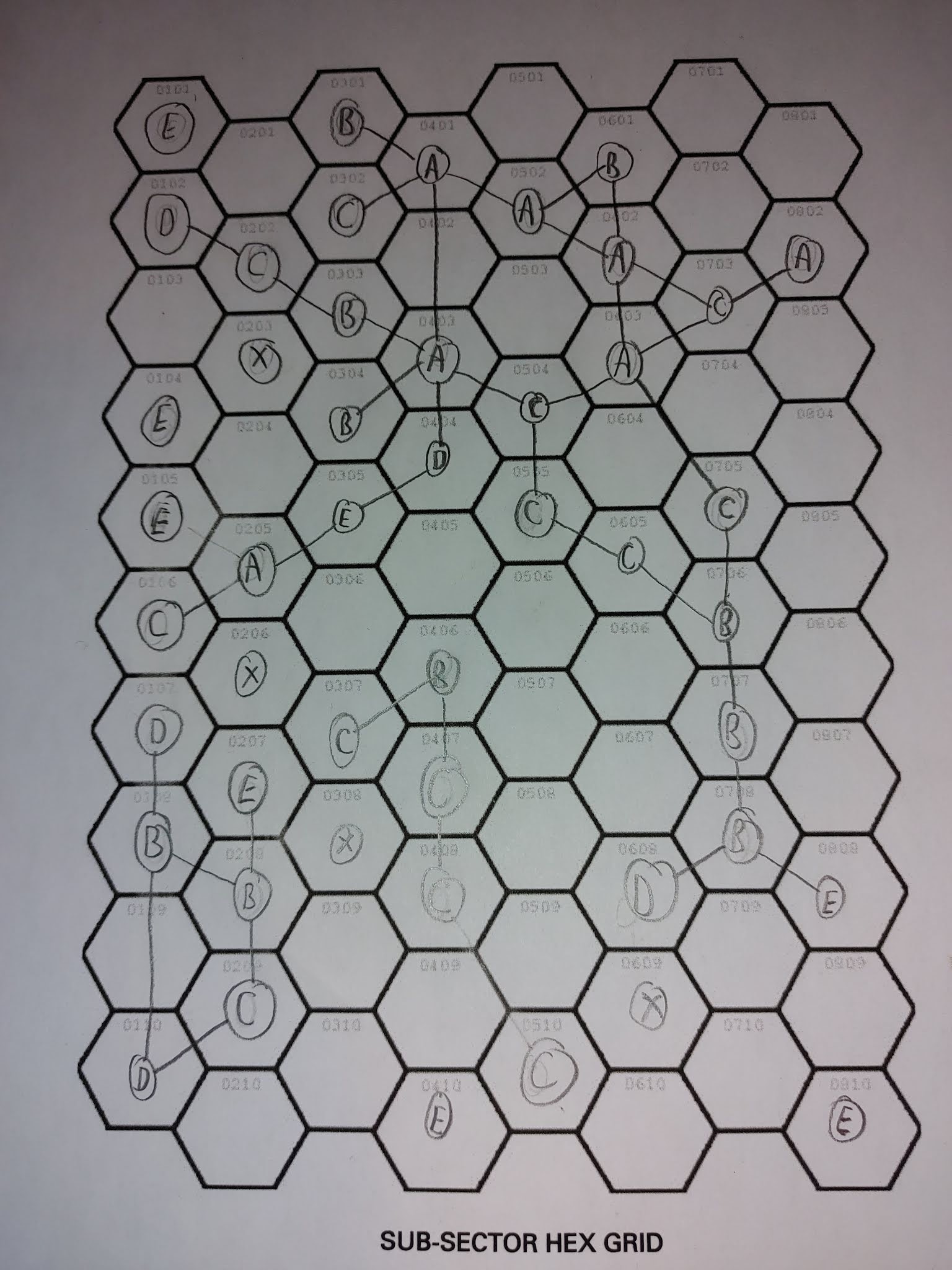
Alright, I've got a map! That's right, I'm creating a subsector. Since page 3 is just a blank hex map, I'm going to begin creating a gaming environment as I go through this book. Who knows? It might end up in a book. Writers do that sort of thing, after all. Even ones who are behind on their personal deadlines.

I started out by making a copy of page 3, then using a spreadsheet to quickly generate the worlds and the starports. I then did the jump routes, and here's what I got:


Not bad, eh? There are a few interesting features of this map. Now, I'm still not 100% up to speed on what these starports mean, but considering how the tables are set up, I'm going to make a few educated guesses. First, 'X' most likely means no starport at all, since there is no 'X' on the jump route table.

Second, that's a nice little string of 'A' ports at the top, isn't it? Six of them within a few hexes, although I managed to roll two 1s when trying to connect the two-hex jumps from 0502 and 0602 to 0403. Still, it's a nice little circular route. If 'A' is the best and richest kind of starport, then I've got my main civilization area figured out.

Third, there are a couple of isolated spots. Those three 'E' ports in the first column (at the top and two in the middle) are jump-route free. Nobody seems to want to go there. Is that because they have no resources worth exploiting? I mean, I even managed to roll a 1 on the A-E connection. That world must really suck.

The second isolated spot is in the bottom half in the middle. There are four stars connected, a B and three C ports. So, the B port is likely the most important one there, but it has no connection to that A port at 0205. I accidentally double-rolled on the C-C connection at the bottom, so you can see the erased marks there. But that C and E are alone down there, next to an 'X' port. They don't even have a connection with each other.

In the bottom-left, there's a larger grouping that's cut off from the rest of he map. Two 'B' ports form the heart, but all six of them are connected in a group. Maybe those two groupings are going to be military opponents. They're both anchored by 'B' ports, not 'A' ports, so maybe they're like the petty kings instead of the imperial overlords in that chunk of 'A' ports at the top.

And then there's that lonely little 'E' port down at the bottom. No one-hex jump world available to even try to connect to it. I just know I'm going to put something awesome down there as an adventure location. It's the space equivalent of the heart of Africa; of course I'm going to make it an adventure spot!

So, there are some interesting possibilities already, and I still have no clue what any of these worlds look like. On to the next page, where we will learn...something new. I'm not looking ahead anymore.

After I'm done creating this subsector, I might have Bard Conley take the Scheherazade out there to explore. Maybe one of those 'A' ports is actually Earth. That would be fun to do. So, if people like the first book, available now on Amazon, let me know. It's pulp-style space action, with pirates, treasures, dangerous monsters, and exotic locations all across the solar system. Check it out!


Sunday, February 7, 2021

The Thousand Nights and a Night, Introduction

So, I said I'd do this on Sundays: A brief review/overview of Sir Richard Burton's The Thousand Nights and a Night, more commonly known to us today as the Arabian Nights tales. For the vast majority of us, our exposure to these stories comes from children's stories and Hollywood movies. And, in an extreme case, a Bugs Bunny cartoon. ("Open...Sasparilla? Open...Saskatchewan?" Ah, the classics never get old.) And the version of these stories we got was invariably family-friendly, with no indication that there even were any naughty bits to take out.

Surprise! This is the unexpurgated version of the stories. That means, the 'unedited' versions, with all the naughty bits left in and described in loving detail. This isn't your childhood Arabian Nights; this is Aladdin done by the Playboy Channel. And judging from the legacy left by Sir Richard Burton, the man who introduced the Kama Sutra to Victorian England, I have no doubt he enjoyed himself immensely.

So, most of us who are familiar with these stories knows how the framing story goes: Once upon a time, there was a king whose wife was unfaithful to him. He had her executed, then decided that all women were unfaithful by nature, so he began marrying young women every day, executing them the following morning to make sure they didn't cheat on him. The vizier's daughter, Scheherazade, worked up a plan to stop the murderous king. When she married the king, she had her younger sister show up before they went to sleep and ask for a story; the king assented to the story, and she told an enchanting tale, not finishing it before the end of the night, and thus the king kept her alive to continue telling these marvelous stories for 1,001 nights before he realized that he loved Scheherazade and she wasn't unfaithful to him after all. And they all lived happily ever after.

Yeah, right. That's the kiddie version. Here's how it actually went down. Brace yourselves; this is going to be a wild ride.

First of all, there were two brothers, both kings. The older, Shahryar, invited the younger, Zaman King of Samarcand, for a friendly visit. As he was leaving, Zaman realized he'd forgotten a gift for his brother. Going back to get it, he finds his wife in bed with a black slave. This didn't sit well with him, and he sliced them both in half with his trusty scimitar. This depressed him, however, and he went to his brother's kingdom feeling quite rotten about the world.

His brother was happy to see him, and did everything he could to help his brother. After a month of so, he invited Zaman to go hunting, but the younger man refused. So, as King Shahryar went hunting, Zaman wandered the palace by himself until he looks through a window and sees his brother's wife and twenty-one other people (including her husband's concubines, so the whole notion of 'faithful marriage' doesn't really fly here) go into a secluded courtyard. And as he watches, they all strip down and go to town in a wild orgy.

I told you, this is wild stuff, especially for Victorian readers. Did I mention that this wasn't available to the general public, but only by special subscription? Yeah.

Anyway, the revelation that his brother's wife was an even worse cheat than his own cheers Zaman up, and while he doesn't explain himself, Shahryar is happy to see him in better spirits. But when he presses Zaman for details, Zaman really, really doesn't want to tell him. But eventually he gives in, and after they leave on a fake hunt, they come back and watch the courtyard in secret, and sure enough Mrs. King and her friends get down and dirty once again. Shahryar and Zaman aren't quite sure how to respond to this, so they just leave the palace altogether in search of someone who has suffered the same indignities that they have.

Well, they run into a Jinni, or at least see him before he sees them, and he's got a beautiful woman with him. These genies are not like Robin Williams at all, by the way. Anyway, he boasts about how awesome he is because he kidnapped her from her wedding night so he could have her virginity all to himself. Nice guy, isn't he? Anyway, he gets drunk and goes to sleep on her lap. She spots the two wayward kings and because she hates the jinni so much, she demands that they get to know her in the Biblical sense, or she'll wake up the jinni to kill them. So, they both give her what she wants, and then she takes their seal rings, adding them to her collection of over five hundred rings.

We haven't even gotten to the Scheherazade part of the story yet.

So, after leaving the jilted jinni, they head back to Shahryar's kingdom and decide that all women are naturally unfaithful. Zaman heads home after Shahryar has his wife executed and makes the vow to begin the marry-screw-kill game, except he does all three with the same girl, all within twenty-four hours. Zaman doesn't show up again before the thousand nights stories happen, so I don't know what he does when he gets home. King Shahryar spends three years doing this every single day, until his chief Vizier can't find any more virgins to sacrifice. Here is where Scheherazade enters the story.

See, Scheherazade and her sister Dunyazad are the vizier's daughters, and Scheherazade insists that she be the next girl to be married to the king. Obviously, the Vizier isn't thrilled with this plan, and he gets to tell the first story in his attempts to stop her crazy plan. That story is the Tale of the Bull and the Ass (Donkey), and it's a fable about an overworked bull who complains to the donkey about his situation. The donkey advises the bull to just roll over and refuse to work or eat. So, when the bull won't do the job, the farmer (who, thanks to a blessing from Allah, understands the language of the animals and knows exactly what's going on) drags the donkey to the plow and makes him do the bull's work while the bull relaxes and spends the day in the spa.

So, the donkey convinces the bull that the farmer's going to send him to the butcher shop if he doesn't get back to work the next day. End of the story, right? Wrong. Now we get the farmer laughing at the banter between the animals, and his wife thinks he's laughing at her. He can't reveal that he knows the language of the animals, or else Allah will strike him dead. She's not buying it, and demands that he tell her, even if it literally kills him. She nags him until he's about ready to tell her just to get it over with and die in peace, and as he's putting his affairs in order he overhears the dogs and chickens talking about it, and the rooster points out that if he can handle fifty hens on his own, the farmer should be able to handle one wife, and advises that he do so in the traditional manner, by beating the crap out of her with a stick until her curiosity is satisfied.

I'm paraphrasing a bit. But you get the idea. Anyway, the farmer follows the rooster's advice, and the Vizier finishes the story by saying he'll do the same thing to Scheherazade if she tries to become the king's next sacrificial bride. However, she doesn't budge, and since the Vizier doesn't have any options, he goes to the king and finally tells him about Scheherazade. She, of course, has the plan I mentioned above, although there's a detail here that didn't make it into the stories I read when I was younger. See, before the king gives her the bridal poke, she asks him if her sister can be there for her last night on earth. The king agrees, and Dunyazad is brought into the room. And then they consummate the wedding, with the sister sitting on the floor nearby.

And then Scheherazade and Dunyazad start the bedtime stories. And this entry is long enough as it is, so I'm going to follow in Scheherazade's footsteps and keep you in suspense as to what stories she is telling the king.

So, like I said, this is definitely not the kid's version of the stories. I'm definitely keeping these books away from my twelve-year-old son; he can read the kiddie version instead for now. I'm not being a prude, but really, this isn't suitable material for young minds.

I will say, though, that it's a good thing the king agreed to hear the stories; if he'd just rolled over and started snoring, the book would have been a lot shorter...

Saturday, February 6, 2021

Let's Read: Traveller, 1977 Edition, Worlds & Adventures, page 2

Okay, we're continuing with jump routes today. As previously mentioned, the jump routes that are generated at this stage will be the charted routes that commercial ships use. Scouts and such can go off to find new routes, but if you're flying commercial, you're going to be stuck with the existing routes. So, it's like if you're flying Southwest Airlines, you can't go from Detroit to Salt Lake City directly; you have to go to Denver first, because they don't do direct flights. Or, at least they didn't when I last flew that way. Which was a long time ago, and let's not get into my age. Moving along.

The Jump Route table is here, and it's pretty straightforward. You determine the distance between two worlds, and check which starports they each have. Find the starport pairing on the chart, and roll 1D. If you throw equal or higher than the number on the chart (based on the jump distance between the two worlds), there's an existing route. Any world next to an 'A' port (1 hex away) is going to have a charted route, although if it's an 'E' port at the other end, you have to roll 2 or more on the die to have the route. If the two worlds are 4 hexes apart, then the only way you might have a route is if both have an 'A' or 'B' port, and even then the odds are long at best.

When checking for routes, only check each pair of worlds once; no re-rolling to get a different result, even if you're checking for routes from the second world of the pair. And if you have worlds 'G' and 'H' connected by a 1-hex jump, and worlds 'H' and 'J' are also connected by a 1-hex jump, you don't need to check 'G' and 'J' for a 2-hex jump, since the route already exists via the connections with 'H'. It saves lines on the page, and makes it more readable.

So, once that's done, you have your basic subsector map finished. Great! Of course, all you have are a bunch of circles with a starport letter and some lines joining them; so far, we don't know what's actually in any of those places.

Thankfully, we now get to the World Creation section of the rules. Now that you know where they are, you can start figuring out what they are. Here, we learn that each world is classified by seven basic characteristics and the tech index (first mentioned in Book 2 when dealing with pharmaceuticals). These do go from 0 to 9, as I anticipated, but they can also have letters, A-Z but skipping 'I' and 'O' since they are too close to the numbers 0 and 1. Most worlds will be done with numbers; the letters are for special and extraordinary situations.

We are also told that there is only one inhabited world per star system. Well, that sucks; it seems to be an arbitrary decision to me. Why couldn't there be two inhabitable worlds orbiting the same star? Just because we were disappointed that we're surrounded by a bunch of dead and empty rocks doesn't mean all start are going to be like that. But, that's what we've got, so that's what we'll stick with for now.

The seven basic planetary characteristics are determined using 2D rolls, with DMs based on previously-generated characteristics. So, if a world has a breathable atmosphere, that might affect its water content, or something else. Small worlds might not be able to hold a breathable atmosphere in the first place due to their low gravity. In addition to the eight generated characteristics, though, the referee can use any other descriptive terms and characteristics he wants to, and he is encouraged to do so to flesh out the individual worlds.

Sounds good to me. Of course, that's the end of the page, so we'll be left in suspense as to what those characteristics are for the moment. But, I think I'm going to start creating a subsector of my own. Since I know the next page is just a hexmap, I'm going to use it to start creating the region that I hope to use in a game some day. And I'll keep building it as I go through the book, just because.

Yeah, that's something to look forward to. I'm going to go piece-by-piece on this over the next little while. I hope it's of interest to people. But I won't just roll dice and announce the results; I'll be creating as I go, so who knows what sorts of things will turn up with the random rolls?

And since you were kind enough to stop by, I would like to recommend my science fiction debut, Bard Conley's Adventures Across the Solar System, available on Amazon in ebook or paperback. You'll even get to see the starship I created at the end of Book 2, the Scheherazade, in action. Check it out; you won't be disappointed.


Friday, February 5, 2021

250 Posts!

Well, there's a milestone. 250 posts since I began this blog last year. Not quite one per day, but a decent pace so far. I still need to be more consistent, of course, but I'll get there.

So, the highlights of my foray into blogging so far would definitely be the Let's Read for Traveller, which has driven most of the traffic I've had. I'm really hoping to get a chance to play this game at some point, because it looks like it would be a lot of fun. I still have a whole book to go through, though, so it's going to be a fun ride to finish it off.

I'm looking forward to the A-Z blog challenge, which I didn't do last year. I'm going to have to get a couple of books finished before then, since they're going to tie into the A-Z concept I've got. With school, work and family taking up time, it's going to be a challenge to get them finished and published by the end of March. Well, sleep is overrated.

So, aside from finishing the Let's Read, I'm considering any other long-term series of posts that might be of interest to readers. Another read-through of a classic game, perhaps? I have a copy of the original Champions rules I could do. Or I could get back to reviewing those Amazing Stories magazines. Those are tough, since I have a lot of reading to do on those.

Actually, while I already said I wouldn't do it, I might consider reviewing the Thousand Nights and a Night books as I go. I'm already up to the seventh night, and there's been quite a bit going on. Maybe I'll throw in a post per week to recap the week's readings. Yeah, that sounds like a fun thing to do. I'll start that on Sunday. In fact, that would be a decent Sunday project.

So, a thank you to those of you who have been reading the blog, whether it's just for the newbie Traveller stuff or because you happen to be a relative. This is a labor of love; I'm not monetizing this blog, I just want to express stuff I can't put into a book and sell. And, if you were ever inspired to buy one of my books because of a blog post I made, then I thank you twice as much.

Back with more Traveller tomorrow; the Worlds book looks like a lot of fun.


Thursday, February 4, 2021

Let's Read: Traveller, 1977 Edition, Worlds and Adventures, page 1

Okay, let's get this thing going! We begin with the section on Worlds. And the very first line of the book is: "The referee has the responsibility for mapping the universe before actual game play begins."

Holy crap. The whole universe? Do we have that much graph paper? Whatever happened to the old, 'start small and build as the campaign goes'? How did anyone ever start a game of Traveller in the first place?!

Sure, the next line reassures the reader that the whole universe isn't necessary 'immediately.' Still. That's a daunting task if I ever heard of one. Are we starting with just a small galaxy, then? No more than a million stars?

Oh, this is interesting. 'In unsupervised play, one of the player scan generate worlds and perform mapping on a turn-by-turn or adventure-by-adventure basis.' So, this is a distinction between the referee and the players, yes? So the players can be involved in the creation of the game setting on their own time? Okay, that would be cool. Show up to the game session, and Bill has a ream of paper filled with planets he put together over the weekend. Pick one, and let's play.

Alright, that's just the first paragraph. This should be fun. Next up, the universe gets broken up into 'sub-sectors.' Not a sector? Just a sub-sector. Oh, and there's one a couple of pages over. Should I break my rule and look ahead? Tempting...tempting...just a peek...

Ah, fine. So, on page 3 there's a hexmap, with the hexes conveniently labeled in a pattern. It looks like it's a four-digit label, the first two digits giving you the column and the last two giving the row. And the grid is 8 by 10 hexes, so there are eighty hexes in a sub-sector. And now, back to your regularly scheduled read-through.

Each hex represents a jump number of 1, so if your ship has a Jump-2 engine, you can move two hexes with a single jump. So the Scheherazade can do that, which gives it a better range than a Jump-1 which can only go to adjacent hexes. Each hex is one parsec in width, or 3.26 light-years. So, a sub-sector is about 26 x 32.6 light-years across. Not quite galaxy-sized, then. The Milky Way galaxy, at approximately 100,000 light-years in diameter, would be 3,067 x 3,846 subsectors. That works out to almost 12 million sub-sectors. I'm going to go out on a limb and say nobody actually mapped a whole galaxy using Traveller rules. It certainly puts that whole 'map the universe' concept into perspective, doesn't it?

So, we map hex-by-hex to see which ones have worlds in them, as well as what kind, if any, of a starport exists in the system. Then the jump routes, or space lanes, are determined. I notice that the focus is on a world (and its star system) rather than on a star and its attendant planets. I suppose that makes sense; when you're playing, you're going to want to go to where the action happens, which is on a planet, not the star. But that does take away the idea of multiple worlds in a single system. Too bad. Still, rules are made to be broken, right?

Next, we're advised that one or two sub-sectors should be sufficient for a campaign, and that a sub-sector averages about 40 worlds. Well, that's not too crowded, I suppose. Oh, but that one or two sub-sector thing is just the beginning of the campaign; eventually, you'll do more mapping as the characters travel to 'parts unknown.'

We're only halfway down the page, by the way. Next, we begin Star Mapping.

First up, is there a world in the hex? Roll a die, and if you roll high (4-6) mark a circle inside the hex. Otherwise, leave it blank. That's how you get 40 worlds in a sub-sector; roughly half of the hexes will get worlds this way. You can, if you wish, modify the roll to make it a more crowded or sparse sector; just apply a +1 or -1 DM to the roll across the subsector (or to a part of it). Again, the focus is on 'world,' not 'star.'

Next, the starports. We have a table! Roll 2D, and mark the circle with the starport's designated letter. A-E, or X are the options. The most common type will be C (7 or 8 on the roll). There are no DMs indicated, so it's a straight roll. 2-4 is an A, 5-6 is a B, 9 is a D, 10-11 is E, and 12 is an X. Oh, but you can create your own starport table if you wish, if the one here doesn't suit your campaign needs. I would comment on how the starport distribution might affect game play, but I don't know what the starport letters actually mean yet. They will be described later. We are told, however, that starports will often have naval or scout bases (good places for characters to originate from), with a wide range of facilities. And starports are considered extra-territorial by the local planets, and thereby not subject to local law.

So, that raises an interesting question. Is the starport on the planet itself, or in orbit around it? Is it even near the planet, or is it halfway across the system? And that raises another bunch of questions. How does the jump system work? Are you jumping to a fixed point in the system, in which case the planet might be on the other side of the star? Is the jump point in orbit around the star, like a planet? Is it orbiting a planet like a moon? Interesting ideas. On the other hand, you might be calculating the jump based on the calculated orbits of the various celestial bodies; to jump from Earth orbit to a planet orbiting Rigel, for example, your jump computer needs to know where in the galaxy Earth is, where Rigel is, and where the target planet orbiting Rigel is, so you don't accidentally jump into a gravity well, or into the planet's core.

I like how the jump mechanics aren't defined (yet, at least), so these questions can be interpreted however the referee wants them to be. A fixed jump point means that infrastructure can grow around it in space, safely away from any planetary orbits. And everyone knows that orbital infrastructure is a great place to have adventures.

Route determination is next, but only part of it is on this page. I'll simply mention that the space lanes are charted, so it's easy to tell where the commercial traffic is going. However, just because the lane isn't charted doesn't mean you can't make that jump. The rest of the paragraph is on the next page, so we'll look at that next time.

Tuesday, February 2, 2021

Book Review: The Moon Pool, Abraham Merritt

This review is not of the 1919 published novel called The Moon Pool. This is actually a review of the original novelette that Merritt published in the June 22, 1918 edition of All-Story Weekly. This was his third published story, following Through the Dragon Glass and The People of the Pit, also published in All-Story Weekly. But this one was the breakthrough, the one that got everyone to sit up and take notice. It was so popular that the publisher asked Merritt to write a sequel. That was published in six parts in early 1919, as Conquest of the Moon Pool. The two stories were then mashed together and edited to create the version that most people who are familiar with the story at all remember the best.

That last part was a convoluted way of saying 'not too many people know about this guy anymore.' But man, he can write a ripping yarn. Merritt's total output is not very heavy; nine novels and nine short stories during his lifetime, with a few fragments published years later. But the influence he laid on the fantasy/weird/horror genres cannot be underestimated.

The Moon Pool is framed as a 'someone told me this' story, wrapped in the conceit of a 'scientific' organization to lend the tale authenticity. The story takes place on a ship in the South Pacific, where Dr. Goodwin encounters an old colleague, Dr. Throckmartin, who is not the man he used to be. The story is told from Throckmartin's perspective as he relates the horrifying tale of what befell himself and his small group of scientists who meddled with things they should have left alone.

According to Throckmartin, his wife, her maid, and his assistant went to the island of Ponape in the Carolines, where the natives warned them to stay away from the island on the nights of the full moon because bad things would happen. Naturally, being scientists, they disregarded the native superstition and determined to study the ruined city of Nan-Matal by the light of the full moon. Oops.

The story seems cliché to modern eyes, but that's because it's men like Merritt and Burroughs who created those clichés in the first place with their incredible stories that truly took popular fiction to places people had never imagined before. They were fresh ideas at the time, and need to be read in that vein. Merritt uses the newness of those clichés to write a tale that drips with weird menace on every page. As Throckmartin tells the tale, the sense of unknowable terrors continues to grow, even as the reader's mind reels at the impossibility of the story. By the end, Throckmartin's fate is sealed, and Goodwin is left with knowledge that would shatter a lesser man.
"Good God!" breathed Throckmartin, and if ever the words were a prayer and an invocation they were. And then, for the first time—I saw—it!
Nearer and nearer it came, borne on the sparkling waves, and less and less grew the protecting wall of shadow between it and us. The crystalline sounds were louder—rhythmic as music from another planet. Now I saw that within the mistiness was a core, a nucleus of intenser light—veined, opaline, effulgent, intensely alive. And above it, tangled in the plumes and spirals that throbbed and whirled were seven glowing lights.
Through all the incessant but strangely ordered movement of the—thing—these lights held firm and steady. They were seven—like seven little moons. One was of a pearly pink, one of delicate nacreous blue, one of lambent saffron, one of the emerald you see in the shallow waters of tropic isles; a deathly white; a ghostly amethyst; and one of the silver that is seen only when the flying fish leap beneath the moon. There they shone—these seven little varicolored orbs within the opaline mistiness of whatever it was that, poised and expectant, waited to be drawn to us on the light filled waves.

Intense, isn't it? And very descriptive. Merritt could turn on the vocabulary when he wanted to, and it shows. And as the story progresses, we know what is going to happen to each member of Throckmartin's party; it's as inevitable as the rising of the moon. But even so, the tale keeps drawing the reader in, making these old clichés seem fresh after all. Just wrap your head around the imagination required to write this:

"As I turned again to call to Stanton, my eyes swept the head of the steps and stopped, fascinated. For the moonlight had thickened more. It seemed to be—curdled—there; and through it ran little gleams and veins of shimmering white fire. A languor passed through me. It was not the ineffable drowsiness of the preceding night. It was a sapping of all will to move. I tore my eyes away and forced them upon Stanton. I tried to call out to him. I had not the will to make my lips move! I had struggled against this paralysis and as I did so I felt through me a sharp shock. It was like a blow. And with it came utter inability to make a single motion. Goodwin, I could not even move my eyes!

"I saw Stanton leap upon the steps and move toward the gateway. As he did so the light in the courtyard grew dazzlingly brilliant. Through it rained tiny tinklings that set the heart to racing with pure joy and stilled it with terror.

"And now for the first time I heard that cry 'Av-o-lo-ha! Av-o-lo-ha!' the cry you heard on deck. It murmured with the strange effect of a sound only partly in our own space—as though it were part of a fuller phrase passing through from another dimension and losing much as it came; infinitely caressing, infinitely cruel!

"On Stanton's face I saw come the look I dreaded—and yet knew would appear; that mingled expression of delight and fear. The two lay side by side as they had on Thora, but were intensified. He walked on up the stairs; disappeared beyond the range of my fixed gaze. Again I heard the murmur—'Av-o-lo-hal' There was triumph in it now and triumph in the storm of tinklings that swept over it. "For another heart-beat there was silence. Then a louder burst of sound and ringing through it Stanton's voice from the courtyard—a great cry—a scream—filled with ecstasy insupportable and horror unimaginable! And again there was silence. I strove to burst the invisible bonds that held me. I could not. Even my eyelids were fixed. Within them my eyes, dry and aching, burned."

Readers voted The Moon Pool the most popular story that All-Story Weekly published in the first half of the twentieth century. Reading it, it's obvious why; Burroughs wrote great adventure stories, and Dunsany wrote fantasy like no one before him or since. Doyle and Haggard created the 'lost world' stories, but Merritt synthesized it all together into a tale so powerful it inspired H.P. Lovecraft himself, the master of weird horror fiction.

So, why doesn't anyone know about this book? How is the man who wrote something like this so obscure today?

Frankly, the answer is Terry Brooks. Fantasy fiction prior to 1977 was a mixed bag, a field where literally anything could happen; Conan knock-offs could fight eldritch horrors on an alien starship and nobody blinked at the weird mix. Pulp fantasy authors from 1920 to the early 1970s were influenced by Dunsany, Burroughs and Merritt, and there were no limits to what they could imagine. Earth so far in the distant future that the sun was red and wizards schemed to steal ancient spells from their rivals; an alternate world where elves and faerie creatures fought a war against the Christian men; a tide-locked Earth where magic and science waged a war; and small hobbits could save the world from ancient evils through their compassion and determination.

All of these were familiar tales to the fantasy readers in the early 1970s. But in 1977, Terry Brooks changed all that with his Sword of Shannara, a book that many people have said is nothing more than a pastiche of the Lord of the Rings. And they would be right; while it is an entertaining read, one I have enjoyed in the past, it really is the herald of the future of fantasy. It's been said that almost all fantasy today is nothing more than people writing Tolkien-style books, epic trilogies with massive worldbuilding and grand quests. I disagree with that assessment; it would be more accurate to say that the majority of fantasy authors today aren't mimicking Tolkien; they just aren't good enough to do that. No, they are mimicking Terry Brooks in their attempts to mimic Tolkien. And that is why there isn't anything new on the shelves anymore; it's all just footnotes to Tolkien and Brooks.

It's a tragic situation, and one that needs to change. And the best way to change that is to bring back the writings of the old masters, the ones who started it all and made fantasy truly fantastic. The sooner we do that, the better. Abraham Merritt being obscure should be an absurd thought to any reasonable fan of science fiction and fantasy. It's no different than fans of vampire romances not knowing about Bram Stoker and Dracula. That's how seminal Merritt is to the fantasy genre.

So, do yourself a favor and check out The Moon Pool. You can find it in its original form at the Internet Archive. Believe me, you won't regret it. Although you might not ever look at the full moon the same way again.

And when you're done with that, you might want to check out my own contribution to pulp fantasy, starting with The Chronicles of Meterra: Arrival.


Monday, February 1, 2021

Utterly Fantastic

For a lot of people my age and younger, fantasy literature began with Tolkien and Lord of the Rings. For the significant number of us who got into fantasy through role-playing games like Dungeons & Dragons, LotR was the most influential book we read. Sure, there were recommended reading lists in the back of the rulebooks (the legendary Appendix N, or the list in the back of the Moldvay Basic book), but Lord of the Rings and its many imitators, such as the Shannara series, were the biggest influences on our gaming and, for some, our writing. Yes, there were those who enjoyed Lovecraft and Howard as well, but unless you were actually using Cthulhu in your games, those influences were comparatively minor.

It's a tragedy, to be honest. There was so much other fantastic stuff out there that we just weren't paying attention to. I've spoken of Edgar Rice Burroughs before, of course; he's the dominant force in pop culture, even if the vast majority of us don't know it. The John Carter movie that Disney put out a few years ago was a pale imitation of the original, but I find it amazing that a lot of people actually thought it was a pale imitation of more recent science-fiction and fantasy movies. Are you kidding me?

John Carter, Burroughs' first great creation (predating Tarzan by a few months in publication) stands at the beginning of pop culture as we know it. Yes, there were heroes like Hercules and Sigurd and King Arthur before him; those are of a different breed. Their influence, while important, pales today compared to John Carter and Burroughs. Without Edgar Rice Burroughs, we would be bereft of Star Wars, Dungeons & Dragons, and Superman, among others.

That's a bold statement, isn't it? But it's true, nonetheless. George Lucas has stated that when developing Star Wars, he couldn't get the rights to Flash Gordon, so he turned back to that character's inspiration: John Carter of Mars. Jerry Seigel, the creator of Superman, stated that he "had Tarzan and John Carter in mind" when he created the Man of Steel. And the original boxed set of D&D booklets had far more references to Barsoom than Middle-Earth; they had to be removed because of issues with the Burroughs estate, and this was well before the publicized problems with the Tolkien estate.

But Burroughs isn't the only one. Inspired by Jeffro Johnson's epic read-through of the books of Appendix N, I've been slowly working my way through the same authors, starting with Dunsany, Burroughs, and Abraham Merritt (the Lord of Fantasy before he was memory-holed in the 1980s). Life has slowed down my reading (and I'm working my way through the Arabian Nights right now), but the stuff I've read so far has been incredible. I'm working on Conquest of the Moon Pool, the original serialized version, and it's so different from everything I grew up reading. But it's recognizably fantasy, too. The kind that we used to read regularly, before we threw out our pop-cultural heritage and replaced it with Game of Thrones. That was not, by any stretch of the imagination, an improvement.

Burroughs didn't just influence D&D, though; Traveller also has some ties to John Carter's stories. In the back of the first Traveller supplement, 1,001 characters, the publisher added nine nameless characters drawn from classic science fiction. The first one? Unquestionably John Carter. And you would not want to get your character on his bad side; he will end you.

Reading these old books may turn some people off, but as I mentioned in my 'About Me,' what's new isn't necessarily an improvement. And when it comes to reading these giants of science-fantasy, they have yet to be improved on.

And while I don't pretend that my own efforts at this sort of writing come up to the lofty standards set by these masters, I'm doing my best to follow in their footsteps, one book at a time. I've even written a book set in the time of these early champions of the genre; it's The Awakening, the first book of the Gilded Age series.